Four things to remember
You don't need to combine "complete proteins" at every meal. Variety across the day covers your amino acids.
Most plant proteins contain less leucine and other essential amino acids than animal proteins, so plan slightly larger portions.
Soy is the strongest plant option for muscle, and research shows it doesn't change male hormone levels.
Protein without resistance training is building material with no builder.
How much: a quick recap
I covered protein targets in detail in a separate article. Link: /articles/protein-after-50 Briefly: the ESPEN expert group recommends at least 1.0 to 1.2 grams of protein per kilogram of body weight per day for healthy older adults, and 1.2 to 1.5 g/kg for those who are ill or malnourished. The PROT-AGE study group advises at least 1.2 g/kg for older adults who exercise. For adults over 50 who lift regularly, I use 1.4 to 1.6 g/kg a day as a practical target.
This article answers the next question, the one I hear most from people moving toward plant-forward eating: can plants do the job?
Myth 1: "Plant protein is incomplete"
This one should have been retired decades ago. A review in the American Journal of Clinical Nutrition concluded that mixtures of plant proteins can be a complete, well-balanced source of amino acids. The Academy of Nutrition and Dietetics states that well-planned vegetarian and vegan diets are nutritionally adequate for all stages of life, including older adulthood and athletes.
What the myth gets wrong is timing. You don't need rice and beans on the same fork. Your body draws on everything you eat across the day. Lentils at lunch and whole-grain bread at dinner work together.
The real difference: leucine and density
The myth is wrong, but the instinct behind it isn't completely off. Plant proteins do differ in measurable ways.
A laboratory analysis of plant protein isolates in Amino Acids found essential amino acid contents of about 21% to 22% for oat, lupin and wheat protein, compared with 43% for whey and 32% for egg. Plant proteins were usually lower in lysine and methionine, and leucine varied widely, from 5.1% in hemp to 13.5% in corn. Leucine matters because it acts as a key signal for muscle protein synthesis. A review in the Journal of Nutrition added that plant proteins tend to be less digestible and that more of their amino acids are diverted away from muscle.
The same review listed practical solutions: eat more plant protein, and combine several sources. That's not a compromise. It's a design choice. If plant protein is a slightly smaller brick, you use a few more bricks.
If plant protein is a slightly smaller brick, use a few more bricks. The wall stands just as well.
What happens in real muscle
Lab measurements of amino acids are one thing. Muscle growth over weeks is what counts, and here the evidence is reassuring.
- Soy vs. animal protein. A meta-analysis of 9 trials with 266 participants found that soy protein supplements produced the same gains in strength and lean mass during resistance training as whey or other animal proteins.
- A fully plant-based diet vs. a mixed diet. In a 12-week trial in Sports Medicine, vegans and omnivores who trained twice a week ate a matched 1.6 g/kg of protein a day. Both groups gained 1.2 kg of leg lean mass, and there were no significant differences in muscle size or leg-press strength. The participants were young men, so this tells us what plants can do when protein is adequate.
- Older adults specifically. In a randomized trial of adults with an average age of 66, a high-protein vegan diet built mainly on mycoprotein supported the same daily muscle protein synthesis rates as an omnivorous diet, in both rested and exercised legs. It was short (3 days) and small, but it measured the process that matters.
- The pooled picture. A 2021 meta-analysis of randomized trials found that protein source did not affect changes in absolute lean mass or strength overall. Animal protein had a modest edge for percent lean mass, mainly in adults under 50.
My read: if you train and eat enough total protein, source is a minor variable. Total intake and the barbell are the major ones.

Myth 2: "Soy will wreck your hormones"
Many men over 50 avoid tofu for exactly this reason. They shouldn't. A meta-analysis of 41 clinical studies found that neither soy protein nor isoflavones affected total testosterone, free testosterone, estradiol or estrone in men, regardless of dose or study length.
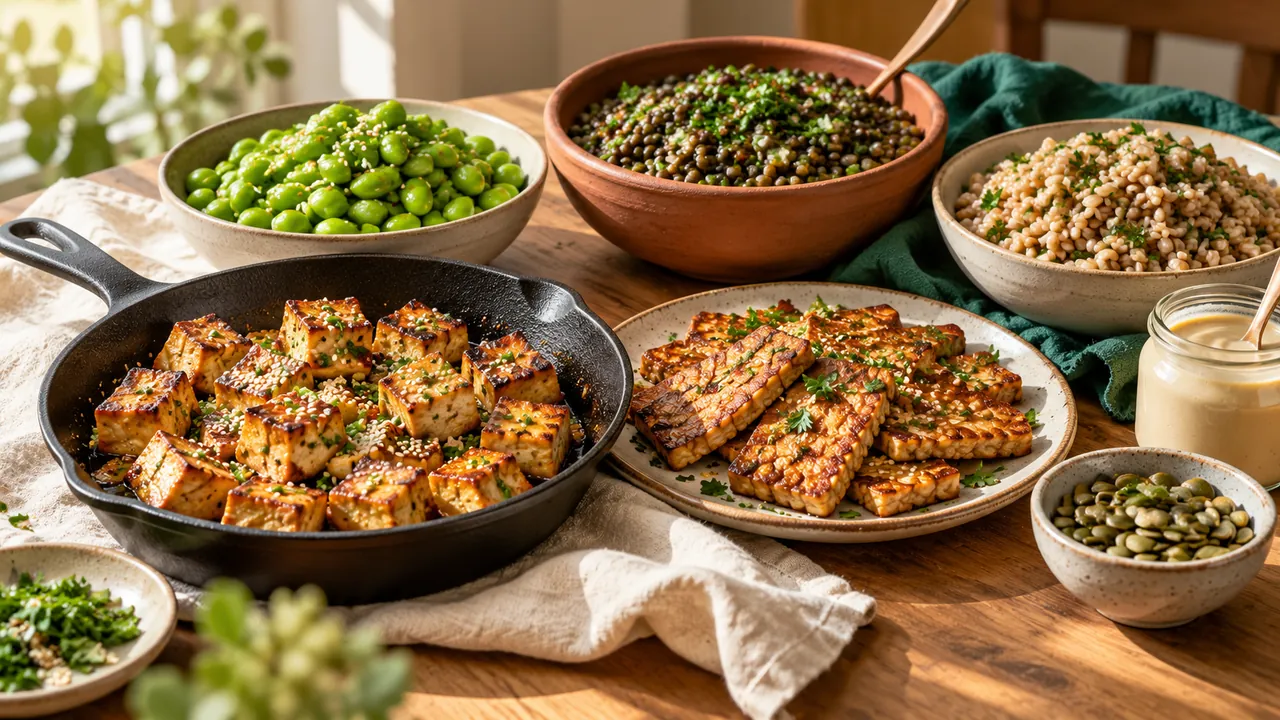
Soy foods such as tofu, tempeh, edamame and soy milk are some of the most protein-dense, highest-quality plant foods available. I treat them as the backbone of a plant-forward protein plan.
The part that matters for the next 30 years
Muscle is one goal; living well for decades is the larger one. Protein never arrives alone. In a cohort of more than 131,000 U.S. health professionals followed for decades, each 3% of calories from plant protein was linked to a 10% lower risk of death from any cause. Animal protein was linked to higher cardiovascular mortality. That's an observational association, not proof, but it points the same way as everything else we know about legumes, fiber and saturated fat.
This is also where I draw a clear line. Carnivore and "animal-based" diets give up the very foods linked to lower risk in exchange for a leucine advantage you can match with a slightly bigger portion of tofu. That's a bad trade.
Put it into practice: a plant-forward protein plan after 50
Set your daily target using the recap above, and plan for the upper end if you lift regularly.
Anchor every meal with a dense source. Per 100 grams, firm tofu provides about 17 g of protein, tempeh about 20 g, shelled edamame about 12 g and cooked lentils about 9 g. One cup of cooked lentils is about 18 g.
Go a little bigger. Make your plant-protein portion about one-quarter to one-third larger than the animal-protein portion you'd have used. That's my rule of thumb for making up the leucine and digestibility gap.
Pair families. Combine legumes with grains, nuts or seeds over the day to fill in lysine and methionine.
Use soy most days. It's the closest plant match to animal protein for muscle.
Use powder for a specific job. A soy or pea-rice blend works well when appetite is low or breakfast is rushed. Look for independent quality testing.
Train. Resistance exercise at least twice a week tells the protein where to go. Link: /articles/strength-training-after-50
Cover B12. A plant-forward diet needs a reliable vitamin B12 source, such as fortified foods or a supplement. Link: /articles/vitamin-b12-plant-forward-diet
For full meal examples, see the high-protein plant-forward day. Link: /articles/high-protein-plant-forward-meals
When general advice is not enough
- People with chronic kidney disease may need to limit protein. PROT-AGE makes an explicit exception for severe kidney disease not treated with dialysis. Ask your nephrologist or a renal dietitian before raising your intake.
- On a GLP-1 medication, with poor appetite or with unintended weight loss, the priority is getting enough food and protein at all. Link: /articles/preserve-muscle-on-glp-1
- If you have a soy allergy, build around lentils, beans, peas, seitan if gluten is not a problem, and mycoprotein.
- A sudden increase in legumes can cause bloating. Add them gradually. Link: /articles/increase-fiber-without-bloating
A few useful follow-ups
Can I build muscle after 50 on a vegan diet? Yes. Trials show plant-based diets support muscle building when total protein is adequate and you train. Older adults have less margin, so hit your target consistently.
Is pea protein as good as whey? Pea protein has less leucine than whey, but larger servings or a pea-rice blend help close the gap. Soy has the most direct evidence of matching whey for strength and lean mass.
Do I need leucine supplements? No. Adequate total protein from dense plant sources and slightly larger portions are the simpler solution.
Is soy safe for women after menopause? Soy foods are a normal part of many traditional diets. If you have a history of hormone-sensitive cancer, discuss soy with your oncology team.
What is the best plant protein for older adults? Soy foods first, then lentils, beans and peas, with whole grains, nuts and seeds filling in across the day.
Sources and further reading
- Deutz NE et al. Protein intake and exercise for optimal muscle function with aging: recommendations from the ESPEN Expert Group. Clinical Nutrition, 2014: https://pubmed.ncbi.nlm.nih.gov/24814383/
- Bauer J et al. Evidence-based recommendations for optimal dietary protein intake in older people (PROT-AGE). JAMDA, 2013: https://pubmed.ncbi.nlm.nih.gov/23867520/
- Young VR, Pellett PL. Plant proteins in relation to human protein and amino acid nutrition. American Journal of Clinical Nutrition, 1994: https://pubmed.ncbi.nlm.nih.gov/8172124/
- Melina V et al. Position of the Academy of Nutrition and Dietetics: vegetarian diets. J Acad Nutr Diet, 2016: https://pubmed.ncbi.nlm.nih.gov/27886704/
- Gorissen SHM et al. Protein content and amino acid composition of commercially available plant-based protein isolates. Amino Acids, 2018: https://pubmed.ncbi.nlm.nih.gov/30167963/
- van Vliet S et al. The skeletal muscle anabolic response to plant- versus animal-based protein consumption. Journal of Nutrition, 2015: https://pubmed.ncbi.nlm.nih.gov/26224750/
- Messina M et al. No difference between soy protein and animal protein on gains in muscle mass and strength with resistance exercise. IJSNEM, 2018: https://pubmed.ncbi.nlm.nih.gov/29722584/
- Hevia-Larraín V et al. High-protein plant-based diet versus a protein-matched omnivorous diet to support resistance training adaptations. Sports Medicine, 2021: https://pubmed.ncbi.nlm.nih.gov/33599941/
- Monteyne AJ et al. A mycoprotein-based high-protein vegan diet supports equivalent daily myofibrillar protein synthesis rates in older adults. British Journal of Nutrition, 2021: https://pubmed.ncbi.nlm.nih.gov/33172506/
- Lim MT et al. Animal protein versus plant protein in supporting lean mass and muscle strength: meta-analysis of RCTs. Nutrients, 2021: https://pubmed.ncbi.nlm.nih.gov/33670701/
- Reed KE et al. Neither soy nor isoflavone intake affects male reproductive hormones: updated meta-analysis. Reproductive Toxicology, 2021: https://pubmed.ncbi.nlm.nih.gov/33383165/
- Song M et al. Association of animal and plant protein intake with all-cause and cause-specific mortality. JAMA Internal Medicine, 2016: https://pubmed.ncbi.nlm.nih.gov/27479196/
- USDA FoodData Central (protein content of tofu, tempeh, edamame, lentils): https://fdc.nal.usda.gov/
- NIH Office of Dietary Supplements, Vitamin B12 consumer fact sheet: https://ods.od.nih.gov/factsheets/VitaminB12-Consumer/
- NIDDK, Healthy eating for adults with chronic kidney disease: https://www.niddk.nih.gov/health-information/kidney-disease/chronic-kidney-disease-ckd/healthy-eating-adults-chronic-kidney-disease
- Related on this site: How much protein after 50 /articles/protein-after-50 · High-protein plant-forward day /articles/high-protein-plant-forward-meals · Strength training after 50 /articles/strength-training-after-50