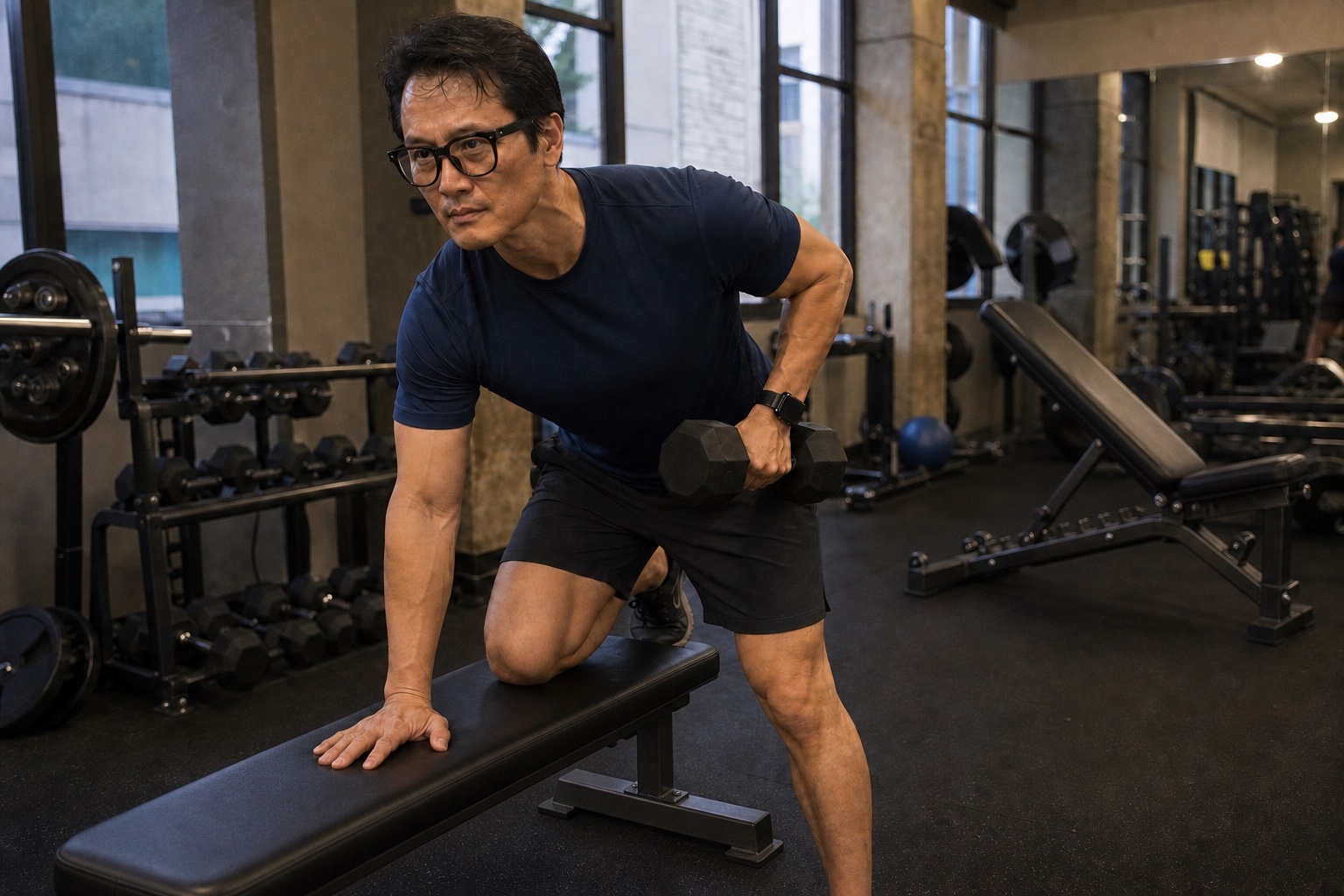
Most adults should strength train all major muscle groups at least twice each week. A beginner can start with six basic movement patterns, one or two sets of 8 to 12 controlled repetitions, and at least one recovery day between sessions. Progress gradually when technique remains steady.
What matters most
Four things to remember
- 01
Two full body sessions each week are enough to make meaningful progress.
- 02
Machines, free weights, bands, and body weight can all work. The best tool is the one you can use safely and progress.
- 03
You do not need to train to failure. Finish most sets with two or three good repetitions still possible.
- 04
Power, balance, and carrying ability matter alongside muscle size.
01
Why strength becomes more important, not less
Muscle helps regulate glucose, supports bone, protects joints, and provides reserve during illness. Strength helps us climb stairs, lift luggage, get off the floor, and recover from a stumble. Those ordinary tasks are the real outcomes behind the gym numbers.
Adults tend to lose muscle and power with age, especially during inactivity. That process is not fixed. Trials consistently show that older adults can improve strength and physical function with resistance training. The program may need to be adapted, but age alone is not a reason to avoid it.
02
Begin with two full body days
Two nonconsecutive sessions each week are a strong starting point. Leave at least a day between them. A third day can be added later if recovery, schedule, and goals support it. More frequency is not automatically better if every session becomes rushed or painful.
Each session can cover six patterns. They do not need to look athletic. A chair squat is a squat. A supported dumbbell row is a pull. A countertop push up is a push. Choose the version that lets you move through a comfortable range with control.
- Squat: sit to stand, goblet squat, or leg press.
- Hinge: hip hinge practice, glute bridge, or light Romanian deadlift.
- Push: wall push up, chest press, or overhead press when appropriate.
- Pull: band row, cable row, or supported dumbbell row.
- Carry: farmer carry, suitcase carry, or a practical loaded walk.
- Calf and balance: calf raise, supported single leg stance, or step work.
03
Sets, repetitions, and effort
Start with one set of 8 to 12 repetitions for each exercise during the first two weeks. If soreness and technique are manageable, move to two sets. The last few repetitions should require attention, but form should remain recognizable.
A useful rule is to stop while you could still perform two or three good repetitions. That is challenging enough for progress without making every set a test. People with more experience may use heavier loads and lower repetitions for strength, or more weekly sets for muscle growth. Beginners do not need that complexity on day one.
04
How to progress without rushing
Progress can mean more than adding weight. You can add a repetition, improve range of motion, move with better control, reduce assistance, or complete the same work with less fatigue. When you can perform the top of the repetition range for every set with steady form, add the smallest available amount of resistance.
Keep a simple log. Exercise, resistance, repetitions, and one note about effort are enough. The log prevents guessing and makes small improvements visible. If performance falls for several sessions while sleep, mood, or joint discomfort worsens, reduce the workload and recover.
05
The first month should feel almost too reasonable
The goal of the first month is not to prove toughness. It is to learn the movements, discover how your body responds, and establish a schedule that survives ordinary life. Mild muscle soreness can be normal. Sharp pain, joint pain that builds with each repetition, dizziness, or symptoms that change your gait are signals to stop and reassess.
Someone who is frail, has osteoporosis, has fallen recently, or has significant joint or neurological disease may benefit from a physical therapist or qualified exercise professional. Good coaching is not a sign that a person is too old to train. It is a way to make the training fit the person.
Put it into practice
A beginner full body session
- 01
Warm up with five to ten minutes of easy walking and practice each movement without weight.
- 02
Chair sit to stand: one or two sets of 8 to 12.
- 03
Supported row: one or two sets of 8 to 12 per side.
- 04
Wall or countertop push up: one or two sets of 8 to 12.
- 05
Glute bridge: one or two sets of 8 to 12.
- 06
Farmer carry: two or three controlled walks of 20 to 40 seconds.
- 07
Supported balance and calf raises: two rounds per side.
Safety first
When general advice is not enough
- Seek medical or rehabilitation guidance after a recent surgery, fracture, acute injury, unexplained chest symptoms, fainting, or a major change in exercise tolerance.
- People with osteoporosis may need to modify loaded spinal flexion and twisting. Technique and exercise selection matter.
- Pain is not required for progress. Persistent joint pain, weakness, numbness, or symptoms that worsen should be evaluated.
A few useful follow ups
How often should adults over 50 lift weights?
At least two days each week is the general recommendation. Full body sessions on nonconsecutive days are efficient and give beginners time to recover.
Is it too late to start strength training at 70 or 80?
No. Older and even frail adults can improve strength and function. The starting exercise, load, supervision, and progression should reflect current ability and medical history.
Do I need a gym?
No. Body weight, resistance bands, adjustable dumbbells, and household carrying tasks can create a useful program. A gym becomes helpful when it offers equipment, coaching, or progression you will actually use.
Sources and further reading
Primary guidance and research reviewed for this article.
American College of Sports Medicine resistance training position stand ↗Resistance training prescription network meta analysis ↗National Strength and Conditioning Association position statement for older adults ↗WHO guidelines on physical activity and sedentary behaviour ↗
Sung Won, MD
Physician by training and health educator focused on evidence based longevity, plant forward nutrition, and habits people can sustain.
Read the full biography →