What the cost research shows
Two studies answer this better than any opinion, including mine.
The first is a randomized trial in Washington, DC. Adults with overweight were assigned to a low fat vegan diet or told to keep eating as usual, and nobody was told to save money. A secondary analysis of 223 participants linked their food records to USDA national food prices. Daily food costs in the vegan group dropped about 16%, while the control group's costs didn't change. The biggest savings came from meat and dairy, and those savings more than covered the extra money spent on vegetables, fruit, legumes, whole grains and meat and dairy alternatives (Kahleova et al., JAMA Network Open, 2023).
That trial was funded and run by a group that promotes plant based eating, and the food costs came from self reported records, so read it as one well designed data point, not the last word. The second study comes from a completely different angle and lands in the same place.
Researchers at Oxford paired food prices from 150 countries with the amounts of food different healthy diets require. In upper middle income and high income countries, healthy and sustainable eating patterns were up to 22 to 34% cheaper on average than what people currently eat. Vegetarian and vegan versions were generally the most affordable, and pescatarian diets were the least affordable (Springmann et al., Lancet Planetary Health, 2021).
The same paper is honest about the other side. In low income and lower middle income countries, those healthy patterns cost at least 18 to 29% more than current diets, because people there already eat a lot of cheap starchy staples and the healthier plate adds more fruit, vegetables and protein. So "is plant forward accessible to everyone in the world" has a real answer: in wealthy countries it's the budget option, and in the poorest countries the barrier is income, not the idea of eating plants.
If you're reading this in the US, cost isn't your reason to skip it.
The staples that do the work
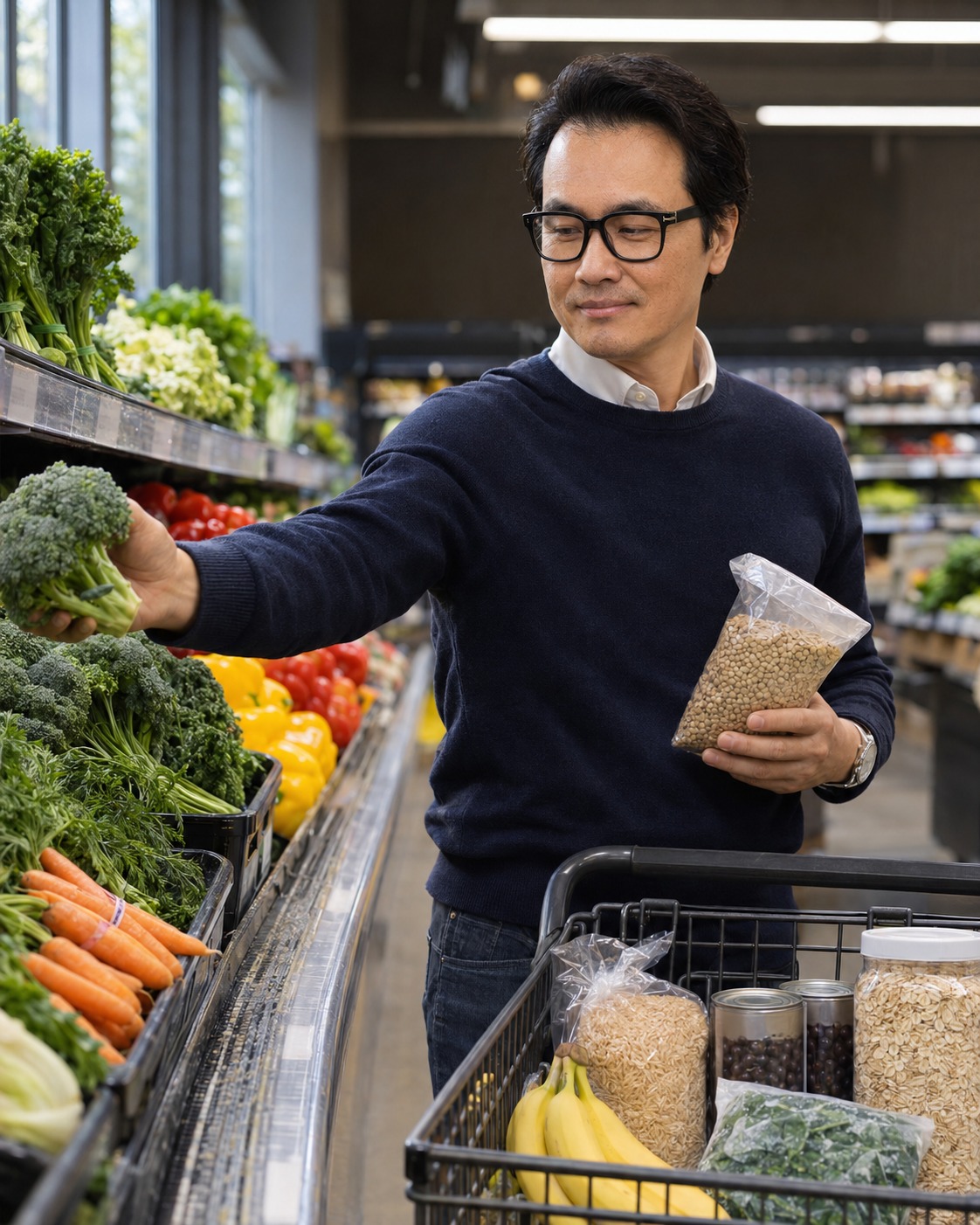
These are the foods I'd build every week around. Each one is cheap per serving, keeps well, and earns its place nutritionally.
Dried or canned beans and lentils. Protein and fiber in the same food, and the backbone of the cheapest meals on earth: dal and rice, rice and beans, lentil soup, black bean tacos. Canned is fine. Rinse them and you cut a lot of the sodium.
Oats. A big canister makes weeks of breakfasts. Plain rolled or steel cut oats, not the flavored packets.
Brown rice, whole wheat pasta, corn tortillas and potatoes. Cheap energy that keeps you full.
Frozen vegetables and fruit. Here's where people leave money and nutrition on the table. Researchers at UC Davis measured vitamins in eight fruits and vegetables stored fresh in the fridge versus frozen, and the frozen versions were comparable and sometimes higher (Bouzari et al., Journal of Agricultural and Food Chemistry, 2015). Frozen broccoli doesn't rot in your crisper drawer, so you throw less away.
Seasonal and long keeping produce. Cabbage, carrots, onions, sweet potatoes, apples, bananas, citrus in winter. These last and cost less than berries flown in out of season.
Tofu, peanut butter and a bag of nuts or seeds. Your protein and healthy fat backups.
Spices, garlic, vinegar and a can of tomatoes. This is what makes cheap food taste like dinner instead of a diet.
A weekly grocery list for one adult
Scale it by the number of people you're feeding. Skip the brand names and buy the store brand.
- 2 bags of dried lentils or 4 cans of beans (mix black, pinto and chickpeas)
- 1 large canister of rolled oats
- 1 bag of brown rice and 1 box of whole wheat pasta
- 1 package of corn tortillas
- 1 block of firm tofu
- 1 jar of peanut butter
- 3 to 4 bags of frozen vegetables (broccoli, spinach, mixed stir fry, peas)
- 1 to 2 bags of frozen berries or mango
- 1 head of cabbage, 1 bag of carrots, 1 bag of onions, a head of garlic
- 3 to 4 sweet potatoes or a bag of regular potatoes
- A bunch of bananas and whatever fruit is in season
- 2 cans of diced tomatoes and 1 jar of salsa
- Soy milk or another fortified plant milk, if you use milk
That basket covers oatmeal with fruit and peanut butter every morning, a big pot of lentil or bean soup, a tofu and vegetable stir fry over rice, bean tacos, and pasta with tomatoes and spinach. It's not fancy. It's food you'll actually eat on a Wednesday.
For days that need more protein, my high protein plant forward day lays out the meals: high protein plant forward meals.
Five swaps that save money
You don't have to overhaul everything at once. Start with the meals you already cook and change the expensive part.
- Chili, tacos and pasta sauce: replace half or all of the ground meat with lentils or beans. Most families don't notice by the second batch.
- Lunch: swap the deli meat sandwich for a big bowl of last night's soup or a bean and grain salad. Leftovers are the cheapest lunch there is.
- Breakfast: replace boxed cereal and breakfast sandwiches with oats, frozen berries and a spoon of peanut butter.
- Snacks: buy a bag of bananas and a jar of peanut butter instead of protein bars.
- Buy whole, not cut. A whole cabbage, a bag of carrots and a block of tofu cost less than the pre cut, pre marinated versions.
Do you need to buy organic?
No. Buy more produce, conventional or organic, whichever you can afford more of.
A Stanford systematic review looked at 17 human studies and 223 studies of nutrient and contaminant levels. It didn't find strong evidence that organic foods are meaningfully more nutritious than conventional ones. Organic produce was less likely to carry detectable pesticide residues, but differences in residues exceeding the allowed safety limits were small (Smith-Spangler et al., Annals of Internal Medicine, 2012).
The bigger health gap is between people who eat a lot of vegetables and people who don't. Don't let the organic label shrink the amount of produce in your cart. Wash everything and move on.
Doing this as a family on a tight budget
Families have it easier than they think, because the cheapest plant foods get cheaper in bulk and cook well in big pots.
Cook two big things on Sunday: a pot of beans or lentils and a pot of rice. Those two pots turn into burritos, soup, rice bowls and stuffed sweet potatoes through Thursday.
Keep the familiar formats. Kids who eat tacos will eat bean tacos. Kids who eat spaghetti will eat it with a lentil sauce. Don't announce it.
Lean on the freezer. Frozen vegetables go straight into soups, pasta and fried rice with no washing, chopping or waste.
If you use SNAP, every item on this list is food you can buy with it.
Where plant forward fits
Plant forward means plants lead the plate, not that every animal food disappears. If you want the full definition and what a plate looks like, start here: what plant forward means. I eat a fully plant based diet myself. My recommendation for most people is to let beans, whole grains, vegetables and fruit take over the center of the plate and see what that does to both your health and your grocery bill.
Health is a choice, and on this one the healthier choice is also the cheaper one.
FAQ
Is plant forward eating cheaper than a regular diet?
For most people in the US, yes. In a randomized trial, people who switched to a low fat vegan diet cut daily food costs by about 16%, mostly by buying less meat and dairy. An Oxford study across 150 countries found healthy, plant heavy patterns were up to 22 to 34% cheaper than current diets in higher income countries.
Does plant forward eating have to be organic?
No. Reviews haven't shown organic food to be meaningfully more nutritious. Eating more vegetables, fruit, beans and whole grains does far more for you than the label.
Can a family eat plant forward on a tight budget?
Yes. Beans, lentils, rice, oats, potatoes, frozen vegetables and bananas are some of the cheapest foods per serving in any store. Cook beans and grains in big batches and use them in meals your family already likes.
Are canned beans as healthy as dried?
They're a good, convenient option. Rinse them to reduce sodium, or buy no salt added cans. Dried beans cost less per serving if you have time to cook them.
Sources
- Kahleova H et al. Vegan diet and food costs among adults with overweight: a secondary analysis of a randomized clinical trial. JAMA Network Open, 2023: https://jamanetwork.com/journals/jamanetworkopen/fullarticle/2808910
- Springmann M et al. The global and regional costs of healthy and sustainable dietary patterns: a modelling study. Lancet Planetary Health, 2021: https://pubmed.ncbi.nlm.nih.gov/34715058/
- Bouzari A, Holstege D, Barrett DM. Vitamin retention in eight fruits and vegetables: a comparison of refrigerated and frozen storage. Journal of Agricultural and Food Chemistry, 2015: https://pubmed.ncbi.nlm.nih.gov/25526594/
- Smith-Spangler C et al. Are organic foods safer or healthier than conventional alternatives? A systematic review. Annals of Internal Medicine, 2012: https://pubmed.ncbi.nlm.nih.gov/22944875/
- Related on this site: What does plant forward mean · High protein plant forward meals · Your grocery cart is a longevity decision