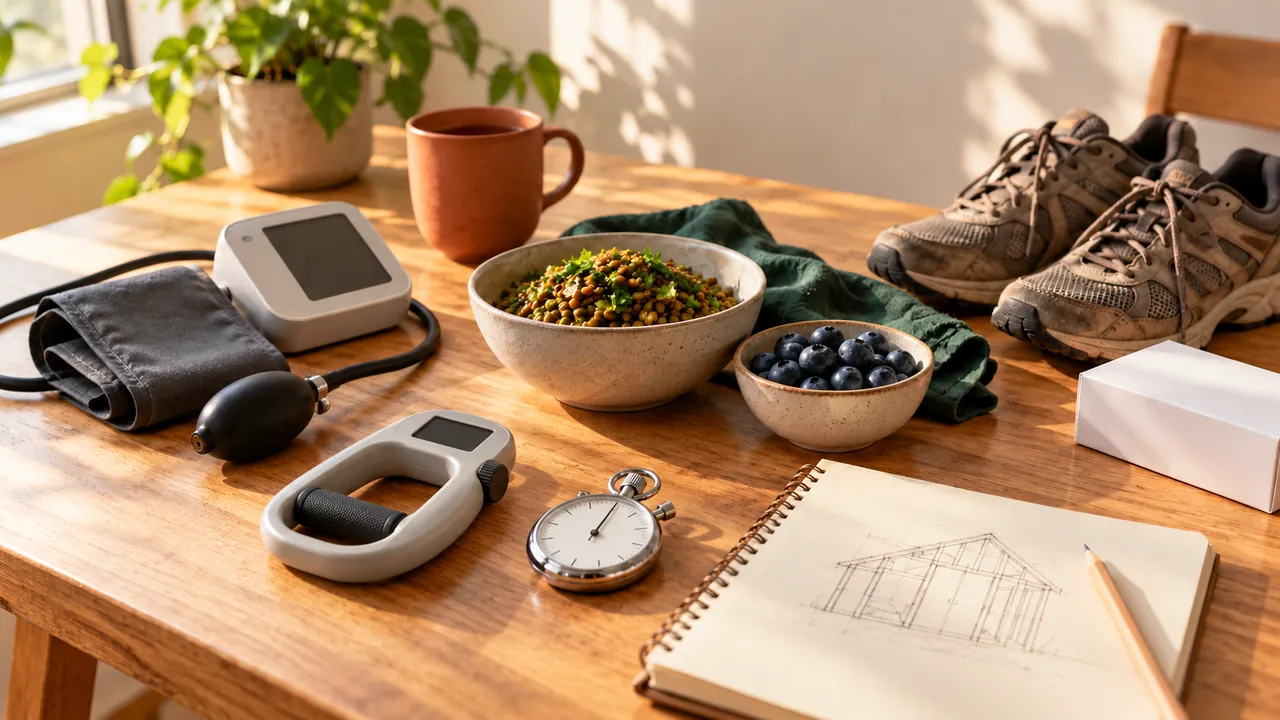
Four things to remember
Epigenetic clocks predict death and disease across populations. They are not a validated diagnostic for one person.
Technical noise alone has produced differences of up to 9 years between replicate runs of popular clocks.
Telomere length is the weakest of the three common tests as a measure of aging.
Cardiorespiratory fitness, grip strength and walking speed predict survival at least as powerfully, and you can train every one of them.
Why a single "biological age" is so appealing
Two 60-year-olds can be very different machines. One climbs stairs two at a time; the other stops at the landing. The idea of biological age is to capture that difference in one number, and the idea is sound.
I wrote about the industry side of this on my other site: how these tests are being marketed faster than they are being validated. This article is different. It is for the person holding a test kit, or a results page, and asking a simple question: can I trust this, and what should I do instead?
My answer is that you should build your health blueprint on measurements that are reliable, that you can act on, and that you can repeat. Most biological age tests fail at least one of those three.
The three tests, compared
1. Epigenetic clocks (DNA methylation)
These tests read chemical tags on your DNA, usually from blood or saliva, and run them through an algorithm. The field has moved through generations. The first clocks, by Horvath and Hannum in 2013, were trained to predict chronological age. Later clocks, such as PhenoAge and GrimAge, were trained on health outcomes and predict death and disease better. GrimAge, for example, predicted time to death, coronary heart disease and cancer in large validation datasets. DunedinPACE takes a different approach: it estimates how fast you are aging right now, not how old you are.
Accuracy: strong for groups, weak for individuals. A 2022 study in Nature Aging found that technical noise alone produced differences of up to 9 years between replicate samples for six leading clocks. Redesigned versions brought most replicates within about 1.5 years, so ask which version your test uses before you trust a single result. DunedinPACE was designed from the start to give consistent results on retesting.
Can it change? In the CALERIE trial, two years of calorie restriction slowed DunedinPACE slightly but did not significantly change PhenoAge or GrimAge. The effects were small. A small twin study found that an 8-week vegan diet lowered several epigenetic age estimates compared with a healthy omnivorous diet, but the vegan twins also ate fewer calories and lost more weight, so the cause isn't clear. These are encouraging research signals. They are not a promise.
Cost: usually the most expensive of the three, because it needs specialized laboratory analysis.
2. Blood-panel ages (phenotypic age)
Phenotypic age combines chronological age with nine routine lab markers, including albumin, creatinine, glucose, C-reactive protein and parts of a complete blood count. In more than 11,000 adults from a national U.S. survey, it predicted death from all causes even after accounting for chronological age, including in people who seemed healthy.
Accuracy: it's built on standardized clinical tests, so the inputs are reliable. The drawback is that a cold, a hard workout or dehydration can move individual markers, and with them the score.
Cost: low. Most of the inputs come from blood work that many adults already get at a routine visit.
My view: a blood-panel age is a reasonable summary, but the individual markers matter more than the composite. If your glucose is high, fix the glucose. The age number adds nothing.
3. Telomere length
Telomeres are protective caps on the ends of chromosomes that shorten as cells divide. It's an elegant story, but a review in the Journals of Gerontology concluded that the evidence that telomere length is a biomarker of human aging is "equivocal."
Accuracy: the weakest of the three for individual use.
Cost: varies by lab and method.
My view: skip it.
Where I stand: measure the levers, not the label
An international consortium of aging researchers wrote in Cell in 2023 that the field still lacks agreed standards for what makes a reliable aging biomarker. Until it has them, I build health plans on four kinds of measurement that predict outcomes, can be tracked over time and respond to effort.
Cardiorespiratory fitness (VO2 max). In more than 122,000 adults who had treadmill testing, low fitness carried mortality risk comparable to or greater than smoking, diabetes or coronary artery disease. The fittest group had the lowest risk. No epigenetic clock has a track record like that, and fitness is something you can train. Link: /articles/vo2-max-after-50
Strength and walking speed. In the PURE study of nearly 140,000 adults across 17 countries, each 5 kg drop in grip strength was linked to a 16% higher risk of death from any cause, and grip strength predicted death better than systolic blood pressure. In a pooled analysis of more than 34,000 adults 65 and older, every 0.1 m/s increase in walking speed was linked to lower mortality. A dynamometer and a stopwatch cost less than a single epigenetic test. Link: /articles/strength-training-after-50
DEXA, when it answers a question. A bone-density DEXA is an established screening tool for osteoporosis. Whole-body DEXA estimates lean and fat mass, which is useful for tracking a training plan if you use the same scanner each time. Link: /articles/dexa-scan-after-50
The blood markers you can act on. These are lipids, glucose or HbA1c, and blood pressure, which isn't a blood test but belongs on the same dashboard. The American Heart Association's Life's Essential 8 combines them with diet, activity, sleep, nicotine and weight. In a study of nearly 12,000 U.S. adults, higher Life's Essential 8 scores were linked to lower biological age, and the strongest links were with blood glucose and blood pressure. In other words, the ordinary checkup markers already track much of what the expensive tests are trying to capture.
A biological age is a label. Fitness, strength and blood pressure are levers. Pull the levers.
A 12-week plant-forward plan to retest against
Think of this as a renovation with a before-and-after inspection. Build the plan around what you can measure.
Week 0: the baseline.
- Resting heart rate and home blood pressure, averaged over a week.
- Waist circumference.
- Grip strength (many gyms have a dynamometer) or a 30-second chair-stand count.
- Walking speed over a timed distance, or a fitness test you can repeat.
- Lipids, fasting glucose or HbA1c, and hs-CRP, ordered and reviewed by your own clinician.
- Optional: an epigenetic test, but only if you will retest with the same lab and the same clock.
Weeks 1-4: the foundation.
- Work toward at least 150 minutes a week of moderate aerobic activity and strength training on 2 or more days. This matches CDC guidance for adults 65 and older, and it works well at 50 too. Add balance work.
- Make plants do most of the work on your plate: legumes at least once a day, a vegetable at every meal, whole grains instead of refined ones, and nuts or seeds daily.
- Keep a consistent wake-up time. Link: /articles/consistent-sleep-schedule
Weeks 5-8: add load.
- Add one interval session a week if it is safe for you. Link: /articles/zone-2-vs-hiit
- Progress your strength work by adding weight or repetitions.
- Choose the protein for each meal first: tofu, tempeh, lentils, beans or edamame. Link: /articles/high-protein-plant-forward-meals
- Cover vitamin B12 with a reliable source. Link: /articles/vitamin-b12-plant-forward-diet
Weeks 9-12: lock it in.
- Keep the schedule. Consistency is the intervention.
- Swap one ultra-processed snack a day for fruit and nuts.
Week 12: the inspection. Repeat every baseline measurement under the same conditions: same time of day, same device, similar hydration. Expect your fitness, strength, blood pressure and lipids to move. Don't expect an epigenetic clock to move much in 12 weeks; even a two-year trial found only small changes. If your clock barely moved but your fitness improved, trust the fitness.

When general advice is not enough
- If you have heart disease, chest pain with exertion, uncontrolled blood pressure, diabetes treated with insulin or other glucose-lowering medication, or joint problems that limit exercise, talk with your clinician before starting interval or heavy strength training.
- An abnormal lab result belongs with a clinician, not a biological age dashboard.
- If tracking numbers makes you anxious or obsessive, track fewer of them. Function is the goal.
- Results from consumer tests are not a diagnosis, and they are not a reason to start or stop any medication.
A few useful follow-ups
Are biological age tests accurate? For groups, reasonably. For one person, not yet. Results can differ by years between labs, between algorithms and even between repeat runs of the same sample.
What is the best biological age blood test? If you want one, a blood-panel phenotypic age built from routine labs is the most practical. If you buy an epigenetic test, choose one that reports a pace-of-aging measure such as DunedinPACE or a reliability-improved clock, and retest with the same provider.
Can a plant-based diet lower biological age? Early studies point in that direction, but they are short and mixed up with weight loss. Eat plant-forward because it improves the markers that matter, not to chase a clock.
Should I test my telomeres? No. The evidence that telomere length works as a personal aging measure is too weak.
How often should I retest? For fitness, strength and blood pressure, every 8 to 12 weeks is useful. For epigenetic clocks, retest only if the result would change what you do.
Which biological age test is most accurate? None of the three is accurate enough to tell one person a true age. Epigenetic clocks are strong for groups and weak for individuals, and repeat runs of the same sample can differ by years. Telomere length is the weakest of the three. A blood-panel age from routine labs is the most practical summary, but the individual markers matter more than the composite.
Sources and further reading
- Horvath S. DNA methylation age of human tissues and cell types. Genome Biology, 2013: https://pubmed.ncbi.nlm.nih.gov/24138928/
- Hannum G et al. Genome-wide methylation profiles reveal quantitative views of human aging rates. Molecular Cell, 2013: https://pubmed.ncbi.nlm.nih.gov/23177740/
- Levine ME et al. An epigenetic biomarker of aging for lifespan and healthspan (PhenoAge). Aging, 2018: https://pubmed.ncbi.nlm.nih.gov/29676998/
- Lu AT et al. DNA methylation GrimAge strongly predicts lifespan and healthspan. Aging, 2019: https://pubmed.ncbi.nlm.nih.gov/30669119/
- Belsky DW et al. DunedinPACE, a DNA methylation biomarker of the pace of aging. eLife, 2022: https://pubmed.ncbi.nlm.nih.gov/35029144/
- Higgins-Chen AT et al. A computational solution for bolstering reliability of epigenetic clocks. Nature Aging, 2022: https://pubmed.ncbi.nlm.nih.gov/36277076/
- Waziry R et al. Effect of long-term caloric restriction on DNA methylation measures of biological aging (CALERIE). Nature Aging, 2023: https://pubmed.ncbi.nlm.nih.gov/37118425/
- Dwaraka VB et al. Epigenetic impact of vegan vs. omnivorous diets on aging: Twins Nutrition Study. BMC Medicine, 2024: https://pubmed.ncbi.nlm.nih.gov/39069614/
- Liu Z et al. A new aging measure captures morbidity and mortality risk across diverse subpopulations from NHANES IV. PLoS Medicine, 2018: https://pubmed.ncbi.nlm.nih.gov/30596641/
- Mather KA et al. Is telomere length a biomarker of aging? A review. Journals of Gerontology A, 2011: https://pubmed.ncbi.nlm.nih.gov/21030466/
- Moqri M et al. Biomarkers of aging for the identification and evaluation of longevity interventions. Cell, 2023: https://pubmed.ncbi.nlm.nih.gov/37657418/
- Mandsager K et al. Association of cardiorespiratory fitness with long-term mortality. JAMA Network Open, 2018: https://pubmed.ncbi.nlm.nih.gov/30646252/
- Leong DP et al. Prognostic value of grip strength (PURE study). Lancet, 2015: https://pubmed.ncbi.nlm.nih.gov/25982160/
- Studenski S et al. Gait speed and survival in older adults. JAMA, 2011: https://pubmed.ncbi.nlm.nih.gov/21205966/
- Lloyd-Jones DM et al. Life's Essential 8, American Heart Association Presidential Advisory. Circulation, 2022: https://pubmed.ncbi.nlm.nih.gov/35766027/
- Zhang R et al. Association between Life's Essential 8 and biological ageing among US adults. Journal of Translational Medicine, 2023: https://pubmed.ncbi.nlm.nih.gov/37710295/
- U.S. Preventive Services Task Force, Osteoporosis screening recommendation: https://www.uspreventiveservicestaskforce.org/uspstf/recommendation/osteoporosis-screening
- CDC, Physical activity guidelines for older adults: https://www.cdc.gov/physical-activity-basics/guidelines/older-adults.html
- Related on this site: DEXA scan after 50 /articles/dexa-scan-after-50 · VO2 max after 50 /articles/vo2-max-after-50 · Strength training after 50 /articles/strength-training-after-50