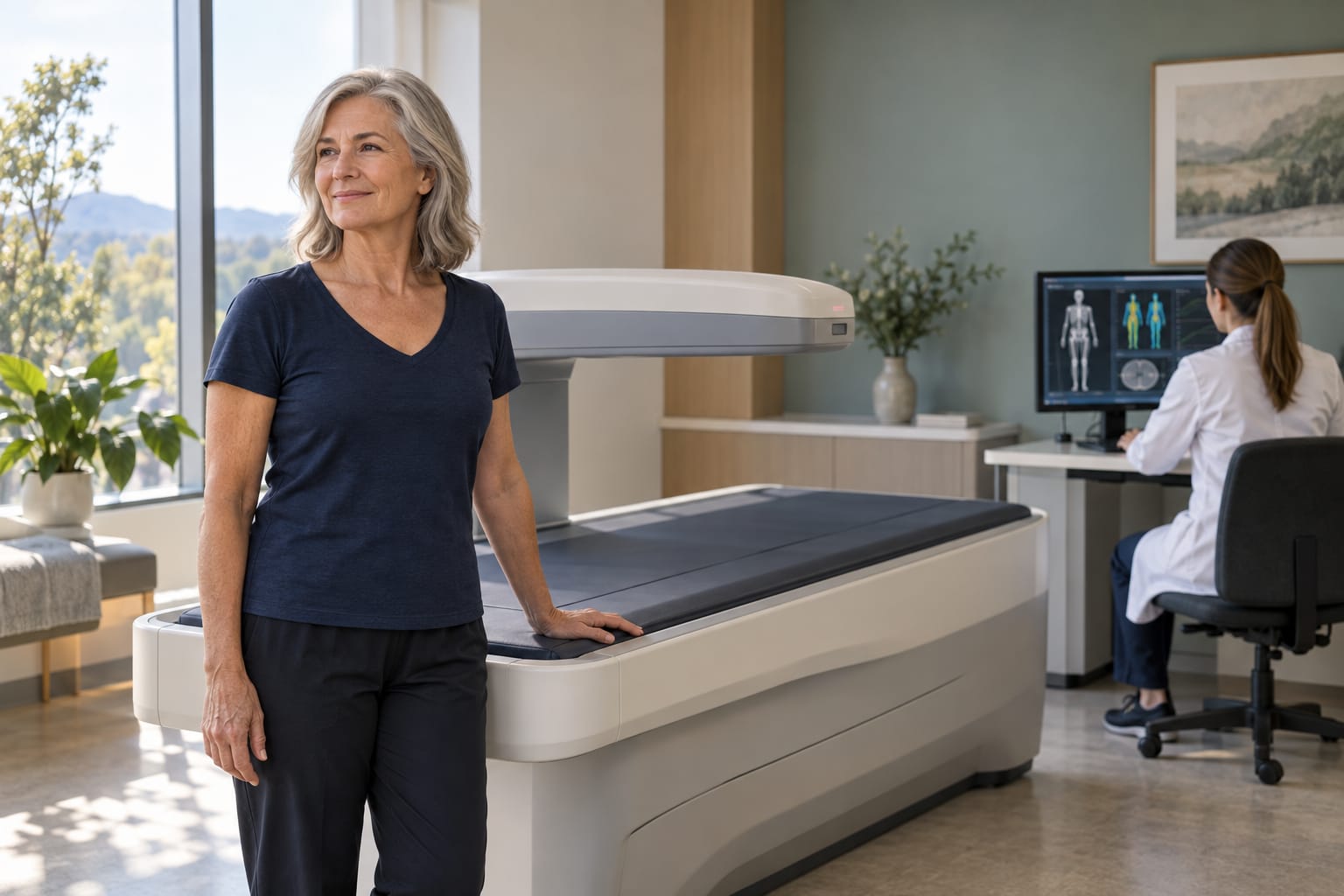
A DEXA scan can be valuable after 50 when it is used for the right reason. Bone-density DEXA is an established tool for osteoporosis screening and fracture-risk decisions. Whole-body DEXA can estimate fat and lean mass, but the result is not a diagnosis of muscle quality or metabolic health. Use the same machine and preparation when following body composition, and interpret the trend alongside strength, waist size, medical history, and function.
What matters most
Four things to remember
- 01
Bone-density DEXA and whole-body composition DEXA answer different questions.
- 02
Screening is recommended for women 65 and older and for younger postmenopausal women at increased fracture risk; evidence is insufficient for routine screening of all men.
- 03
Hydration, food, recent exercise, positioning, software, and the scanner itself can change body-composition estimates.
- 04
A scan becomes more useful when it changes a decision about bone health, training, nutrition, or follow-up.
01
First decide which DEXA question you are asking
DEXA stands for dual-energy X-ray absorptiometry. A clinical bone-density study usually measures the hip and lumbar spine and reports bone mineral density, T-scores, and Z-scores. A whole-body composition study estimates bone mineral, fat mass, and lean soft tissue by region.
One appointment may produce both kinds of information, but the evidence and clinical purpose are not the same. Bone-density DEXA is used in established osteoporosis pathways. Body-composition DEXA is often used to follow a training, nutrition, or weight-management plan and needs more context.
02
Who should consider bone-density screening
The 2025 U.S. Preventive Services Task Force recommendation supports osteoporosis screening for women age 65 and older. It also supports screening postmenopausal women younger than 65 when a clinical risk assessment shows increased fracture risk. For men, the Task Force concluded that evidence is still insufficient to recommend routine population screening.
Those recommendations apply to screening people without known osteoporosis or a prior fragility fracture. A fracture after a minor fall, long-term glucocorticoid use, certain endocrine or gastrointestinal conditions, very low body weight, or other clinical risks can justify a different discussion at an earlier age.
03
How to read the bone portion
A T-score compares bone density with the average peak bone density of a young reference population. A Z-score compares it with people of similar age and sex. Neither number directly measures bone strength, and fracture risk also depends on age, falls, medications, previous fractures, smoking, alcohol, and other conditions.
The most useful report identifies which sites were measured, whether positioning or arthritis affected the image, and how the result fits with a clinical fracture-risk assessment. Treatment decisions should not be made from a screenshot or a single number without that context.
04
What lean mass and body fat do—and do not—mean
Whole-body DEXA is useful for estimating regional fat and lean mass with low radiation exposure. Lean mass, however, includes water and other non-fat soft tissue. It is not a direct measurement of muscle strength, muscle quality, or athletic performance.
Visceral-fat estimates and body-fat percentages are model-based outputs. Research shows good group-level relationships with MRI or CT in many settings, but agreement is not perfect for an individual. Different manufacturers and software versions can also produce meaningfully different values.
05
Make repeat scans comparable
If you are tracking body composition, use the same facility, scanner, software, time of day, and preparation whenever possible. Arrive similarly hydrated, avoid a large meal beforehand, and avoid hard training that changes fluid distribution. Record major medication, illness, or weight changes.
Ask the facility for its least significant change—the amount a result must move before the difference is likely to exceed measurement noise. A small shift in lean mass or body fat may not represent a biological change.
06
Pair the scan with measures that matter in life
A useful healthy-aging dashboard combines structure with function. Consider blood pressure, waist circumference, walking pace, chair stands, grip or lifting progress, balance, and cardiorespiratory fitness alongside the scan.
If the result does not change what you will do, repeating it frequently adds cost and anxiety without much value. The aim is not to chase the lowest body-fat percentage. It is to preserve bone, strength, mobility, and metabolic health over time.
Put it into practice
Before you book a DEXA scan
- 01
Write down the decision you want the scan to inform: fracture screening, a clinical evaluation, or body-composition tracking.
- 02
Ask whether the order is for hip and spine bone density, whole-body composition, or both.
- 03
Bring relevant fracture history, medications, health conditions, and prior scan reports.
- 04
For body-composition follow-up, use the same scanner and similar hydration, food, exercise, and timing.
- 05
Review bone results with a qualified clinician and ask how they affect your actual fracture risk.
- 06
Track strength and function between scans instead of waiting for an image to tell you whether the plan is working.
Safety first
When general advice is not enough
- Pregnancy, recent contrast imaging, implanted devices, severe spinal arthritis, prior surgery, and positioning limitations can affect whether and how a study is performed. Tell the imaging facility in advance.
- A body-composition result should not be used to justify crash dieting, dehydration, or obsessive testing. People with a history of disordered eating may need a different monitoring approach.
- A low-trauma fracture or sudden loss of height deserves clinical evaluation even if a previous scan was reassuring.
A few useful follow ups
Is DEXA the same as a bone density test?
DEXA is the technology. A clinical bone-density test usually focuses on the hip and spine, while a whole-body DEXA estimates fat and lean mass as well as bone mineral.
How often should I repeat a DEXA scan?
There is no universal schedule. Bone-density follow-up depends on baseline risk and whether a change would affect care. Body-composition follow-up should be infrequent enough that expected change is larger than measurement noise.
Is DEXA body fat percentage exact?
No. It is a useful estimate, not a direct count of every tissue. Scanner model, software, hydration, food, exercise, and positioning can influence the result.
Does a normal DEXA mean my muscles are healthy?
Not necessarily. Lean mass does not directly measure strength, power, muscle quality, balance, or endurance. Pair the scan with functional measures.
Related reading
Build the full picture
Sources and further reading
Primary guidance and research reviewed for this article.
USPSTF 2025 recommendation on osteoporosis screening ↗Review of DEXA body-composition methods and limitations ↗DEXA and MRI comparison of visceral and subcutaneous fat ↗Review of body-composition methods in older adults ↗
Sung Won, MD
Physician by training and health educator focused on evidence based longevity, plant forward nutrition, and habits people can sustain.
Read the full biography →