Key points
Colorectal cancer is now the leading cause of cancer death in Americans younger than 50, and incidence in adults 20 to 49 is rising about 3% a year.
In a BMJ meta-analysis of prospective studies, every 10 grams of daily fiber was linked to about 10% lower colorectal cancer risk.
Whole grains and cereal fiber showed the clearest protection. In one large US cohort, total fiber alone wasn't significant, but whole grains were.
My daily minimum is 30 to 40 grams, with a goal of 60. Get there from whole plant foods over several weeks.
Screening starts at 45. Rectal bleeding or a change in bowel habits needs a doctor's visit at any age.
Colorectal cancer is hitting younger people
The American Cancer Society's own reports put it plainly. Colorectal cancer is now the leading cause of cancer death in Americans younger than 50, according to its Colorectal Cancer Statistics, 2026. It ranks first among men under 50 and second among women, behind breast cancer. In the late 1990s it was fourth for both.
The trend line is what worries me. Overall, colorectal cancer incidence is falling, driven by screening in people 65 and older. In adults 20 to 49, it's rising about 3% a year. Death rates in people under 50 have climbed about 1% a year since 2004. Tumors in the lower colon and rectum make up much of the increase.
Nobody has pinned down a single cause. Diet, body weight, inactivity, alcohol and changes in the gut microbiome are all under study. But one part of the picture is already clear and fully in your control: what you eat every day, and how much fiber is in it.
What the research shows about fiber
A 2021 umbrella review in JAMA Network Open graded the evidence from 45 meta-analyses of prospective studies on diet and colorectal cancer. Out of 109 diet links, only five reached the top "convincing" grade. Higher fiber was one of them. People eating the most fiber had about 16% lower risk than those eating the least. Red meat and heavy drinking landed on the other side of the ledger, with convincing evidence of higher risk.
More fiber, more protection. A 2011 BMJ meta-analysis of 25 prospective studies found that every 10 grams of daily fiber was linked to about 10% lower colorectal cancer risk. Cereal fiber showed the same 10% drop per 10 grams. Three servings of whole grains a day was linked to 17% lower risk.
Two larger umbrella reviews point the same way for health overall. A 2025 review in Clinical Nutrition pooled 33 meta-analyses covering more than 17 million people. Across 38 health outcomes, 29 showed lower risk with more fiber, with the strongest evidence for death from cardiovascular disease, pancreatic cancer and diverticular disease. A 2025 meta-meta-analysis in Critical Reviews in Food Science and Nutrition found that the highest fiber intakes were linked to 22% lower cancer risk overall and 17% lower cancer mortality, with a stronger link for cancers of the digestive tract.
Where the fiber comes from makes a difference
Here's the part that gets lost in the headlines, and it makes the case for whole food even stronger.
In the BMJ analysis, fruit, vegetable and legume fiber didn't reach statistical significance on their own. Cereal fiber and whole grains did. The NIH-AARP Diet and Health Study, which followed nearly 479,000 US adults for 16 years, found the same thing from another angle. People eating the most whole grains had 16% lower colorectal cancer risk and 24% lower rectal cancer risk. Total fiber by itself wasn't significant. Fiber from grains was, at 11% lower risk.
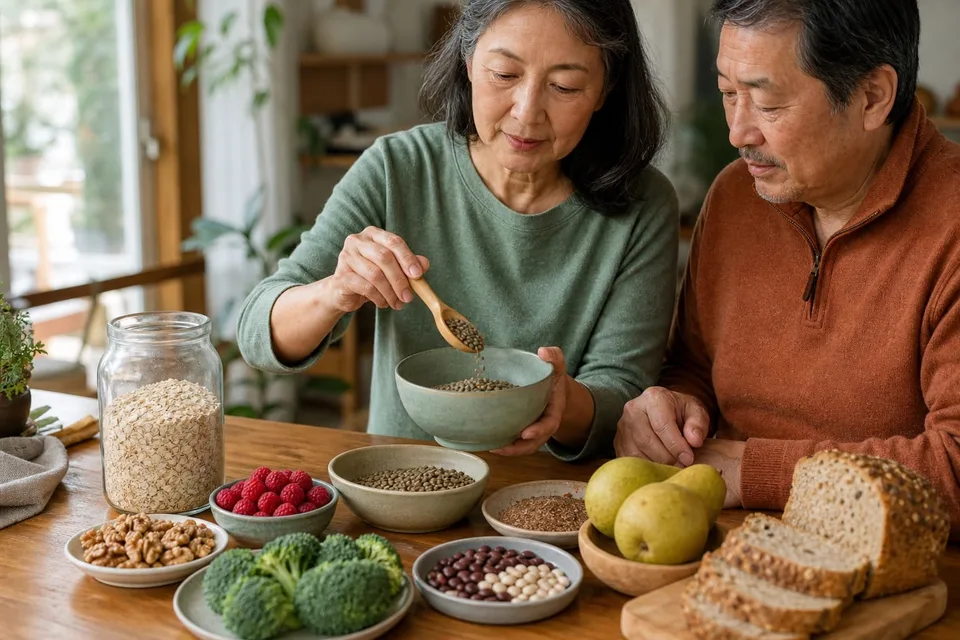
My read is simple. The protection comes from the whole package in whole foods: the fiber, the resistant starch, the folate and minerals in the grain, and the plant compounds that ride along. A spoonful of powder in a glass of water can't copy that. Supplements have a place for regularity. They're no substitute for oats, brown rice, barley, beans and greens.
Fruit, vegetables and legumes still belong on your plate every day. They feed different gut microbes, they carry their own nutrients, and they make 60 grams a day possible. The data simply tell you to make sure intact whole grains are in the mix.
Why fiber protects the colon
Much of the fiber you eat reaches your colon intact, where gut bacteria ferment it. One of the main products is butyrate, a short-chain fatty acid. Butyrate is the preferred fuel for the cells that line your colon. It helps keep the gut barrier tight, calms inflammation in the bowel wall, and short-chain fatty acids also signal gut cells to release GLP-1, the same hormone that helps regulate appetite and blood sugar.
Fiber also adds bulk and speeds transit, so whatever is in your stool spends less time in contact with the colon wall. Fewer refined foods and more plants usually come along with a high-fiber diet as well.
The target: 30 to 40 grams minimum, 60 as the goal
The usual advice is about 25 to 30 grams a day, and the 2025 Clinical Nutrition review found that intake falls short of recommended levels around the world. I set the floor higher, at 30 to 40 grams, and the goal at 60, because the research keeps pointing the same direction: more fiber from whole plant foods, lower risk. Sixty grams a day isn't extreme. It's what a plate built mostly on plants delivers.
If you're at 15 grams today, don't jump to 60 tomorrow. Your gut needs time. I walk through the pace in detail in how to increase fiber without bloating, but the rules are short:
- Add 3 to 5 grams at a time, then hold for several days before the next step.
- Drink water with every meal, and more if you're adding bran, chia or psyllium.
- Spread it across the day instead of loading one meal.
- Rotate many kinds of plants. Different fibers feed different microbes.
Most people can reach 40 grams in three to four weeks and 60 over the next month or two.
What 60 grams looks like in a day
Fiber values come from USDA FoodData Central. Here's one way to get there:
| Meal | Food | Fiber |
|---|---|---|
| Breakfast | 1/2 cup dry rolled oats, cooked | 4 g |
| 1 cup raspberries | 8 g | |
| 1 tablespoon ground flaxseed | 2 g | |
| Lunch | 1 cup cooked lentils, as soup or a bowl | 16 g |
| 2 cups raw spinach | 1 g | |
| Snack | 1 medium pear | 6 g |
| 1 ounce almonds (about 23) | 4 g | |
| Dinner | 1 cup cooked black beans | 15 g |
| 1 cup cooked brown rice | 3 g | |
| 1 cup cooked broccoli | 5 g | |
| Total | about 63 g |
Swap freely. One ounce of chia seeds adds about 10 grams. A cup of cooked chickpeas adds about 12. A medium artichoke, a cup of green peas or a cup of blackberries each adds about 7. Beans and lentils are the heavy lifters. A cup a day gets you a third of the way to your goal.
Screening and symptoms
Food lowers risk. It doesn't replace screening. The US Preventive Services Task Force recommends colorectal cancer screening for all adults starting at 45. Colonoscopy and stool-based tests both count, so ask your doctor which fits you and how often to repeat it. If colorectal cancer runs in your family, you may need to start earlier.
At any age, don't sit on these symptoms: rectal bleeding or blood in your stool, a change in bowel habits that lasts more than a few weeks, stools that stay narrower than usual, belly pain that keeps coming back, unexplained weight loss or iron deficiency anemia. Don't let anyone, yourself included, write them off because you're young. Get them checked without delay.
Where I stand
Health is a choice, and this one is made three times a day. Put beans or lentils on your plate daily. Make your grains whole. Eat fruit and vegetables at every meal. Hit 30 to 40 grams as your floor, then keep building toward 60. Start now, at whatever age you are.
This article shares my opinion based on my interpretation of the published studies cited below. Education, not medical advice.
Sources
- Siegel RL, Wagle NS, Star J, Kratzer TB, Smith RA, Jemal A. Colorectal cancer statistics, 2026. CA Cancer J Clin. 2026;76(2):e70067. https://doi.org/10.3322/caac.70067
- Siegel RL, Giaquinto AN, Jemal A. Cancer statistics, 2024. CA Cancer J Clin. 2024;74(1):12-49. https://doi.org/10.3322/caac.21820
- Veettil SK, Wong TY, Loo YS, et al. Role of diet in colorectal cancer incidence: umbrella review of meta-analyses of prospective observational studies. JAMA Netw Open. 2021;4(2):e2037341. https://doi.org/10.1001/jamanetworkopen.2020.37341
- Aune D, Chan DS, Lau R, et al. Dietary fibre, whole grains, and risk of colorectal cancer: systematic review and dose-response meta-analysis of prospective studies. BMJ. 2011;343:d6617. https://doi.org/10.1136/bmj.d6617
- Hullings AG, Sinha R, Liao LM, et al. Whole grain and dietary fiber intake and risk of colorectal cancer in the NIH-AARP Diet and Health Study cohort. Am J Clin Nutr. 2020;112(3):603-612. https://doi.org/10.1093/ajcn/nqaa161
- Veronese N, Gianfredi V, Solmi M, et al. The impact of dietary fiber consumption on human health: an umbrella review of evidence from 17,155,277 individuals. Clin Nutr. 2025;51:325-333. https://doi.org/10.1016/j.clnu.2025.06.021
- Arayici ME, Basbinar Y, Ellidokuz H. High and low dietary fiber consumption and cancer risk: a comprehensive umbrella review with meta-meta-analysis involving meta-analyses of observational epidemiological studies. Crit Rev Food Sci Nutr. 2025;65(9):1617-1630. https://doi.org/10.1080/10408398.2023.2298772
- Hamer HM, Jonkers D, Venema K, et al. Review article: the role of butyrate on colonic function. Aliment Pharmacol Ther. 2008;27(2):104-119. https://doi.org/10.1111/j.1365-2036.2007.03562.x
- Tolhurst G, Heffron H, Lam YS, et al. Short-chain fatty acids stimulate glucagon-like peptide-1 secretion via the G-protein-coupled receptor FFAR2. Diabetes. 2012;61(2):364-371. https://doi.org/10.2337/db11-1019
- US Preventive Services Task Force. Screening for colorectal cancer: US Preventive Services Task Force recommendation statement. JAMA. 2021;325(19):1965-1977. https://doi.org/10.1001/jama.2021.6238
- US Department of Agriculture, Agricultural Research Service. FoodData Central (SR Legacy). https://fdc.nal.usda.gov/
A few useful follow ups
How much fiber should I eat a day to lower colorectal cancer risk?
My recommendation is a daily minimum of 30 to 40 grams, with a goal of 60. In a BMJ meta-analysis of 25 prospective studies, each 10 grams of daily fiber was linked to about 10% lower colorectal cancer risk. Fiber intake falls short of recommended levels around the world.
Do fiber supplements work as well as food?
The strongest results come from food, especially whole grains and cereal fiber. In the NIH-AARP study of nearly 479,000 adults, whole grains were linked to 16% lower colorectal cancer risk while total fiber on its own wasn't statistically significant. A supplement can help with regularity, but it doesn't replace beans, grains and plants.
Is colorectal cancer really the leading cancer death under 50?
Yes. The American Cancer Society's Colorectal Cancer Statistics, 2026 report ranks it first among cancer deaths in adults younger than 50. It's first in men under 50 and second in women, behind breast cancer.
How fast can I increase my fiber?
Add about 3 to 5 grams at a time, hold for several days, then add more. Drink water with meals and spread fiber across the day. Most people can reach 40 grams in three to four weeks and 60 over the following month or two.
When should I get screened for colorectal cancer?
The US Preventive Services Task Force recommends screening for adults 45 to 75. Don't wait for 45 if you have rectal bleeding, a lasting change in bowel habits, unexplained weight loss or iron deficiency anemia. Get those checked without delay.