What matters most
Four things to remember
- 01
Plant origin and degree of processing describe different aspects of a food.
- 02
A food's nutrient profile still matters when it is labeled plant-based.
- 03
Studies of whole diets cannot prove that one ingredient or packaged product causes disease.
- 04
Convenient food can support a sustainable eating pattern; perfection is not the goal.
01
A package is not a nutritional verdict
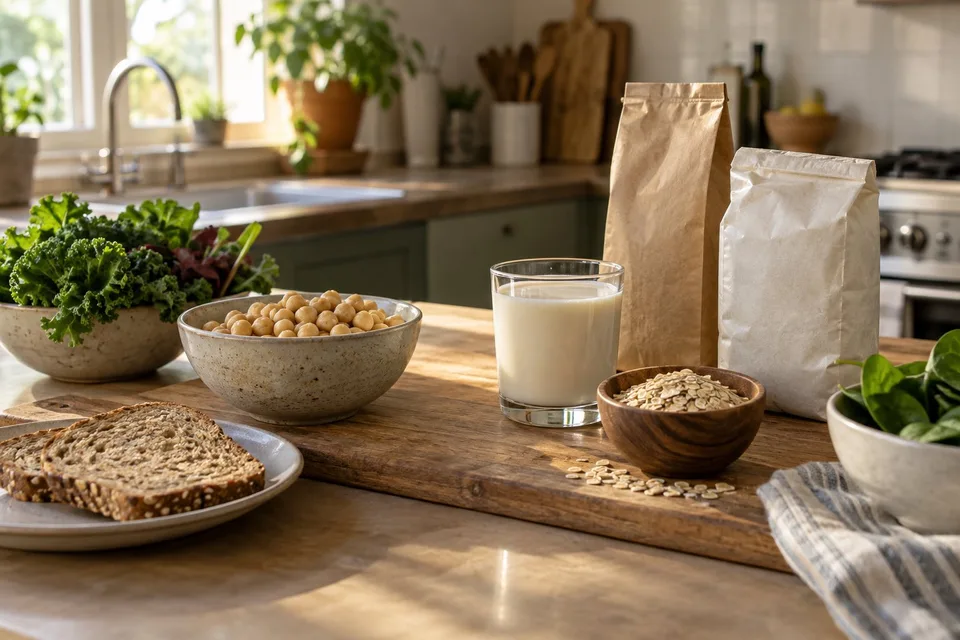
Frozen vegetables, canned beans, oats, and many other convenient staples arrive in packages. Packaging alone does not tell you whether something is ultra-processed. That classification concerns industrial formulation and processing, not simply whether a food comes in a bag.
Likewise, a plant-based cookie is still a cookie. The helpful question is not whether the marketing sounds healthy. It is whether the food contributes something useful to the meals you actually eat. Convenience, cost, enjoyment, and nutrition all belong in that decision.
02
What the plant-food research actually shows
A 2024 UK Biobank analysis followed more than 126,000 adults. Higher consumption of non-ultra-processed plant foods was associated with lower cardiovascular risk; higher consumption of ultra-processed plant foods showed the opposite association. The categories included many foods, not just modern meat alternatives.
This was observational research using dietary reports, not a trial assigning people to particular products. Residual confounding and food-classification uncertainty remain. It cannot establish that a specific plant burger causes heart disease or that all plant-based convenience foods have the same effect.
03
A feeding trial adds nuance, not a forbidden-food list
In a 2025 randomized crossover trial, participants received two eight-week diets that both followed UK healthy-eating guidance. Weight decreased on both; the minimally processed diet produced a larger average reduction. Fifty participants contributed to the intention-to-treat analysis.
The result supports considering processing alongside nutritional quality. It does not establish long-term disease effects, identify one responsible additive, or predict your response to an individual product. The trial supplied entire diets, and the order of the diets also influenced results. Its lesson is about patterns, not a purity test.
04
Use the back label for a fair comparison
Compare foods that serve the same purpose and check the serving size first. For a staple you eat often, look at fiber and protein alongside sodium, saturated fat, and added sugar. A product can perform well on one measure and poorly on another.
The FDA's general label guide treats 5% Daily Value or less per serving as low and 20% or more as high. Those percentages help compare products; they are not individualized nutrition targets. A short ingredient list is not a substitute for checking nutrients, allergens, and the amount you actually eat.
05
Make one practical substitution
Choose a repeat purchase, not your entire pantry. For example, compare two breakfast cereals for fiber and added sugar, or compare two ready-made soups for sodium and a useful bean or lentil component. This is a shopping method, not a claim that one number determines overall health.
Keep easy options that help you eat consistently. Add frozen vegetables to a ready meal, use canned beans to build a quick lunch, or serve a convenience protein with whole grains and produce. A realistic pattern repeated most weeks is more useful than an elaborate plan that disappears when life gets busy.
Put it into practice
A five-minute grocery check
- 01
Pick one packaged staple you buy regularly.
- 02
Compare the same serving amount across two realistic alternatives.
- 03
Check fiber, protein, sodium, saturated fat, added sugar, and allergens.
- 04
Ask what the food will replace and what else belongs in that meal.
- 05
Choose an affordable option you enjoy; reassess the whole pattern rather than chasing a perfect label.
Safety first
When general advice is not enough
- Kidney disease, food allergies, diabetes treatment, swallowing difficulty, or prescribed diets can change appropriate food choices. Follow individualized guidance.
- Do not remove dependable foods if doing so leaves you under-fueled or intensifies food anxiety. Seek a registered dietitian's help when restrictions become difficult to manage.
- Plant-based labels do not establish nutritional adequacy for a fully vegan diet; nutrients such as vitamin B12 need deliberate planning.
A few useful follow ups
Are all packaged foods ultra-processed?
No. Packaging is not the definition. Plain frozen vegetables, for example, are different from industrially formulated snacks.
Should I stop eating plant-based meat alternatives?
Not automatically. Compare the nutrient profile, portion, frequency, and food it replaces. Current whole-diet evidence does not establish a single verdict for every product.
Is an ingredient list enough to judge a food?
No. Check the Nutrition Facts panel, allergens, serving size, and role in your overall diet as well.
Can convenience foods fit a plant-forward diet?
Yes. Convenient staples can make meals achievable. Build the pattern around varied plants and adequate nutrition rather than treating food preparation as a test of discipline.
Related reading
Build the full picture
Sources and further reading
Primary guidance and research reviewed for this article.
Plant-sourced foods, processing, and cardiovascular outcomes: UK Biobank analysis ↗2025 randomized trial of minimally processed and ultra-processed diets ↗FDA guide to percent Daily Value ↗NIH vitamin B12 fact sheet ↗
Sung Won, MD
A longevity & performance educator and health coach focused on evidence-based longevity, plant-forward nutrition, and habits people can sustain. His career began in orthopedic spine surgery.
Read the full biography →