Balance activities belong alongside aerobic and strength exercise as people age. Structured exercise reduces falls in community-dwelling adults aged 65 and older who are at increased risk. Walking is valuable, but it is not a substitute for every balance skill. If you feel unsteady or have fallen, start with an assessment and an appropriately supervised program.
What matters most
Four things to remember
- 01
Fall prevention is a better goal than winning a one-leg-standing challenge.
- 02
Balance, strength, and walking support different parts of daily function.
- 03
Evidence concerns exercise programs, not a single social-media drill.
- 04
Dizziness, medication effects, vision, footwear, and the home environment also matter.
01
What the evidence actually supports
The 2024 USPSTF recommendation supports exercise interventions for adults 65 and older living in the community who have increased fall risk. Its evidence review found fewer falls with exercise across multiple trials. Programs often included balance, walking-related skills, functional movement, and strength.
That does not establish one best drill or guarantee that no participant will fall. Results from structured programs cannot automatically be applied to an unsupported exercise performed alone. The recommendation is also not a complete plan for people with neurological disorders or complex rehabilitation needs.
02
Walking is a foundation, not the entire structure
CDC guidance includes aerobic, muscle-strengthening, and balance activities for older adults. A regular walk can support the aerobic part of that pattern, while an appropriate balance program deliberately practices control of the body in different positions and movements.
Think about everyday tasks you want to preserve: turning in a hallway, stepping onto a curb, dressing, or reaching for a shelf. These are useful discussion points for a physical therapist or qualified instructor. They are more meaningful than comparing your stopwatch result with a stranger's.
03
Choose the setting before the challenge
For someone already steady and cleared for general exercise, the first decision is where practice can happen safely: a clear, level floor, suitable shoes, and a sturdy fixed support. A rolling chair, slippery socks, stairs, or an unstable surface add hazards without making a beginner plan better.
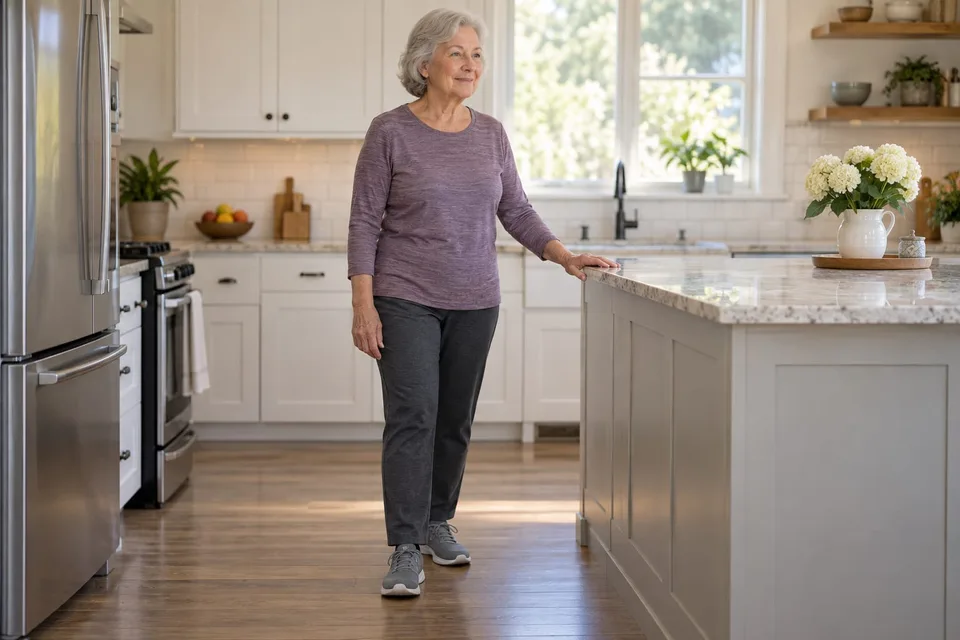
If you have a recent fall, recurrent near-falls, dizziness, or a new change in walking, do not start by testing yourself with your eyes closed or taking away hand support. Ask for a fall-risk assessment. A tailored program can set the starting level and explain how to progress. The image accompanying this article illustrates support, not a prescribed exercise sequence.
04
Home-based programs can be useful when they are structured
A Community Preventive Services Task Force document on home-based exercise for adults 65 and older was updated in July 2026 with supporting review appendices. Its context emphasizes training and support for maintaining fitness at home. This is not a new trial proving that any improvised home routine prevents falls.
When comparing programs, ask who designed it, how ability is assessed, whether modifications are available, and how progress is reviewed. A short routine that fits your home and has an appropriate safety plan may be more realistic than a challenging video with no adaptation. Keep walking and strength work in the broader plan as your abilities allow.
05
Look beyond the exercise session
CDC fall-prevention guidance also emphasizes reviewing medicines, vision, and household hazards. Bring a list of recent falls or near-falls to a clinical visit, including where they happened and whether you felt lightheaded. Do not stop medicines on your own.
At home, a practical first step is to notice the route you use at night and whether lighting, loose rugs, cords, or clutter make it harder to navigate. These observations can guide a safety conversation without turning your living space into an obstacle course.
Put it into practice
Build a safer balance plan
- 01
Write down one daily movement you want to feel more confident doing.
- 02
Report falls, near-falls, dizziness, or new unsteadiness to a clinician.
- 03
Ask about a structured balance-and-strength program suited to your abilities.
- 04
Prepare a clear space with sturdy support before any approved home practice.
- 05
Review progress and difficulty with the program leader rather than removing support to chase a score.
Safety first
When general advice is not enough
- Do not attempt unsupported balance tests if you are unsteady, have fallen recently, or need a walking aid.
- New weakness, fainting, severe dizziness, or sudden trouble walking can require urgent medical evaluation.
- After surgery, a fracture, or with neurological disease, follow your rehabilitation team's guidance rather than this general article.
A few useful follow ups
Is walking enough for balance?
Walking is useful activity, but older-adult guidance also includes balance and muscle-strengthening work.
Does a one-leg test tell me how long I will live?
No individual balance result can predict your lifespan. It is more useful to discuss function and fall risk than to treat a test as a forecast.
Should I exercise at home or in a class?
Either may be suitable when the program matches your needs. If you are unsteady or at increased risk, seek qualified assessment and supervision.
Related reading
Build the full picture
Sources and further reading
Primary guidance and research reviewed for this article.
USPSTF fall-prevention recommendation ↗2024 systematic review of fall-prevention interventions ↗CDC older-adult activity guidance ↗CPSTF home-based exercise update, 2026 ↗CDC fall-prevention steps ↗
Sung Won, MD
Physician by training and health educator focused on evidence based longevity, plant forward nutrition, and habits people can sustain.
Read the full biography →