Test 1: grip strength and the dead hang
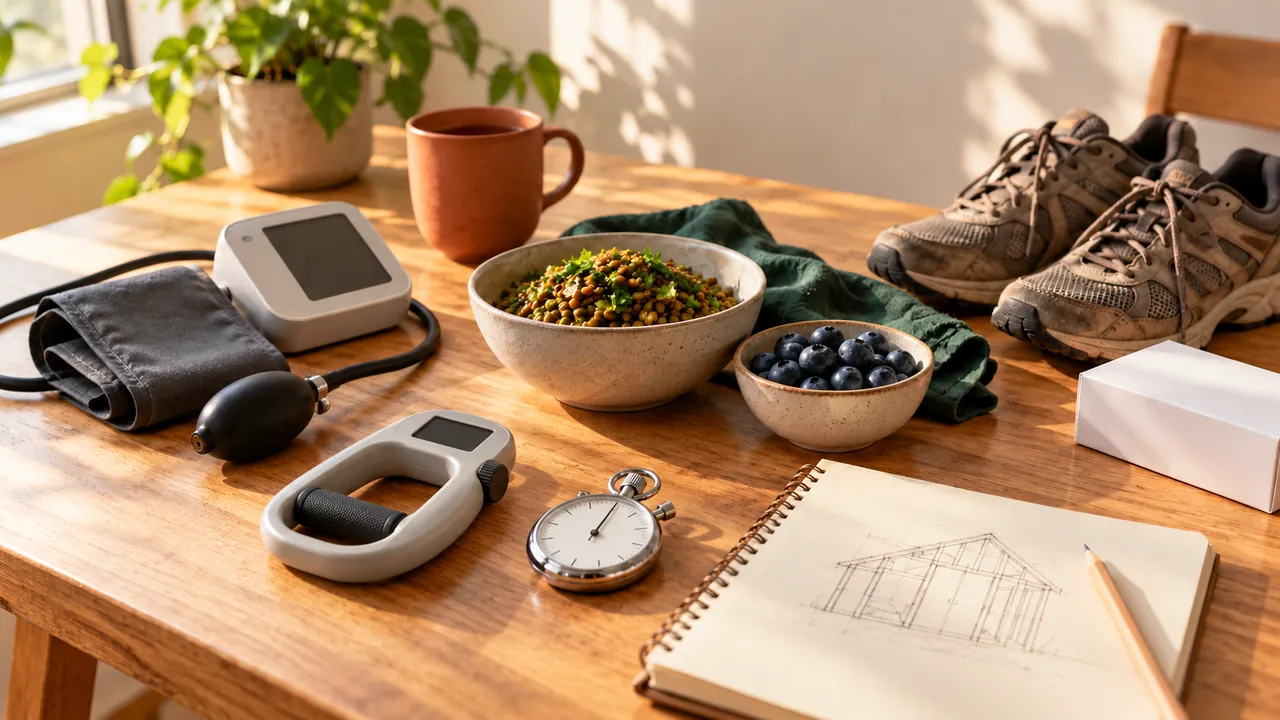
Grip strength is one of the best studied markers of mortality we have. In the PURE study, Leong and colleagues measured grip in 139,691 adults across 17 countries. Every 5 kg drop in grip was tied to a 16% higher risk of death from any cause and a 17% higher risk of cardiovascular death. Grip predicted all cause and cardiovascular death better than systolic blood pressure did (Leong et al., The Lancet, 2015).
Think about that. Your blood pressure gets checked at every visit. Hardly anyone checks your grip.
There's nothing magic about your hands. Grip is a stand in for total body muscle, and muscle buffers your blood sugar, protects your joints and keeps you upright when you stumble.
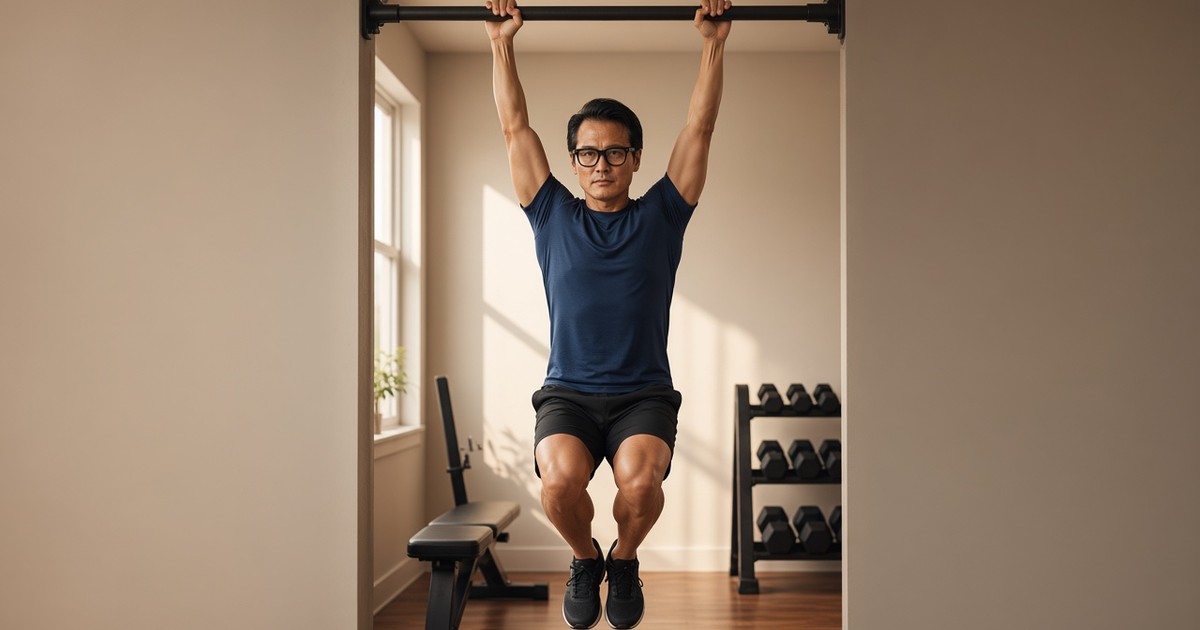
Testing it. If you own a hand dynamometer, squeeze it three times with each hand and record your best. If you don't, do a dead hang. Grab a pull up bar overhand at shoulder width, lift your feet off the floor and hang until you let go.
Targets. Nobody has studied the dead hang against mortality the way they've studied grip, so treat these as my working benchmarks and not study cutoffs. For men 40 to 60, 60 seconds is the floor, 90 is solid and 2 minutes is excellent. For women 40 to 60, 45 seconds is the floor and 60 to 90 is solid. If you can't hold 30 seconds at any age, your grip and upper body strength are slipping.
Fixing it. Three days a week, do 3 dead hangs to near failure and some farmer's carries. For the carries, pick up the heaviest dumbbells you can hold with good posture and walk 30 to 40 meters, 3 to 4 rounds. Heavy rows and deadlifts build grip as a side effect. Stay consistent and you should see 20% to 30% more hang time in two months.
Test 2: the sit to rise test
This one comes out of Brazil, and I love how simple it is. Brito, Araújo and colleagues asked 2,002 adults aged 51 to 80 to sit down on the floor and stand back up using as little support as they could. Everyone started at 10 points and lost a point each time a hand, knee, forearm or the side of a leg touched down for help.
Over about 6 years, the lowest scorers (0 to 3) had a 5.44 times higher risk of death than the top scorers. Each point gained was tied to 21% better survival (Brito et al., European Journal of Preventive Cardiology, 2014).
Testing it. Go barefoot on a clear floor. Cross your feet, lower yourself to sitting, then stand back up. Start at 10 and subtract 1 point for each hand, knee or forearm you use, plus half a point if you lose your balance. Do it twice and keep the better score.
Target. 8 or higher. If you're under 60 and you train, go for 10. Below 8, make this a priority.
Fixing it. The test exposes weak spots in hip mobility, leg strength and balance all at once, so you have to work on all of them. Do goblet squats to a low box (3 sets of 8 to 12) and split squats, and practice getting down to the floor and back up without your hands, 5 reps a day. Most people pick up a point or two in a month from the practice alone.
Test 3: the 10 second one leg stand
Balance drops off fast after the mid 50s. Araújo and colleagues asked 1,702 adults aged 51 to 75 a single question: can you stand on one leg for 10 seconds? About 1 in 5 couldn't. Over a median of 7 years, 17.5% of the people who failed died, against 4.6% of those who passed. After adjusting for age, sex, BMI and medical conditions, failing was tied to an 84% higher risk of death from any cause (Araújo et al., British Journal of Sports Medicine, 2022).
The failure rate roughly doubled every 5 years after 51. Among people aged 71 to 75, more than half couldn't do it.
Testing it. Stand barefoot and rest the front of your free foot against the back of your standing calf. Keep your arms at your sides and look straight ahead. Hold for 10 seconds. You get three tries per leg.
Target. Ten seconds is the pass mark, and I treat it as a bare minimum. Work toward 30 seconds on each leg with your eyes open. Under 60? Try 10 seconds with your eyes closed too.
Fixing it. Balance is a skill, so practice it. Stand on one leg while you brush your teeth, a minute per side, morning and night. Twice a week, add single leg Romanian deadlifts. Most people who fail this test can pass it within 6 weeks.
Test 4: gait speed
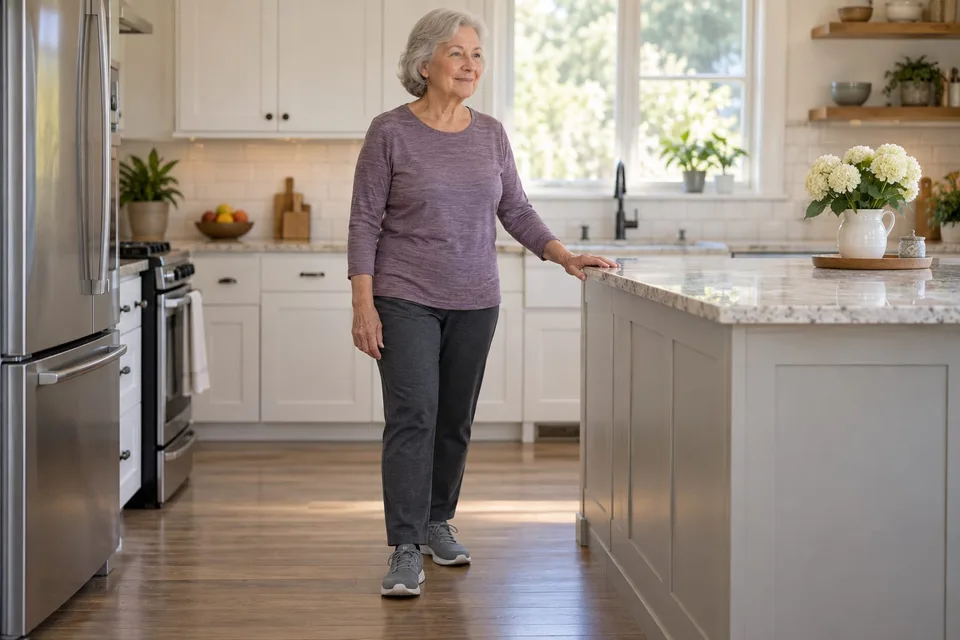
Some people call walking speed the sixth vital sign, and the data support the label. Studenski and colleagues pooled 9 cohorts, 34,485 adults aged 65 and older, followed for up to 21 years. Every 0.1 meter per second of extra speed was tied to a 12% lower risk of death. For 75 year old men, predicted 10 year survival ranged from 19% to 87% based on walking speed alone. Around 0.8 m/s tracked with average life expectancy. Faster than 1.0 m/s pointed to better than average, and above 1.2 m/s pointed to exceptional (Studenski et al., JAMA, 2011).
Walking fast takes your heart, lungs, muscles, nerves and balance working together. So a walk down the hallway ends up testing nearly everything.
Testing it. Mark off 4 meters (about 13 feet) in a hallway or on the driveway, with a starting line 1 meter before it so you're already moving when the clock starts. Walk at your normal pace and time the 4 meters. Divide 4 by your time in seconds. Then repeat at the fastest pace you can walk safely.
Target. At your usual pace, at least 1.2 m/s, which means covering 4 meters in about 3.3 seconds. If you're under 65 and well below 1.0 m/s, act now.
Fixing it. Walk fast on purpose. Three times a week, do 20 to 30 minutes of brisk walking with 5 or 6 one minute pushes at the fastest pace you can hold. Add calf raises and step ups. Leg power is what drives walking speed, and it's the first thing to fade with age.
Why I picked these four
None of these tests looks at a single organ. Each one asks your muscles, nerves, joints and cardiovascular system to work together, and that cooperation is exactly what aging breaks down first.
I've seen this for decades. The people who bounce back fastest from an injury or an operation usually aren't the ones with the prettiest scans. They're the ones who can still get up off the floor, carry their own bags and stand on one leg to pull on their pants.
These are observational studies. Grip, balance and walking speed are markers, and a marker isn't a cause. I still don't think that's a reason to wait. Strength training, power work, balance practice and brisk walking move these numbers, and they also have strong trial evidence behind them for longer, healthier lives. Training the marker costs you nothing, and you build up everything underneath it along the way.
Your 20 minute scorecard
Run these tonight and write down the results:
| Test | Pass | Strong |
|---|---|---|
| Dead hang | 60 s (men), 45 s (women) | 2 min (men), 90 s (women) |
| Sit to rise | 8/10 | 10/10 |
| One leg stand | 10 s each leg | 30 s each leg, 10 s eyes closed |
| Gait speed (usual pace) | 1.0 m/s | 1.2 m/s or faster |
Pick your weakest and train it three times a week for 8 weeks. Then retest, and keep retesting every 6 months.
I can't think of a better use of 20 minutes for your health this year. Health is a choice, and you can make this one on your living room floor.
A commercial age test is a different question, and I don't think it beats these floor tests. I explained why in are biological age tests accurate. If a watch times the walk, read wearable numbers after 50 before you trust the score. If a GLP-1 is in the picture, the muscle plan is in your doctor should have told you this before your GLP-1.
The science of a longer, stronger life.
A few useful follow-ups
Do these tests need a lab? No. A chair, a stopwatch, a pull up bar or a sturdy grip trainer and a clear strip of floor are enough. I want every adult over 40 to run them twice a year and write the numbers down.
Are the dead hang times from a mortality study? No. Grip strength has that kind of evidence. Nobody has studied the dead hang against mortality the same way, so treat the times as my working benchmarks, not study cutoffs.
What do I do with a weak score? Train the weakest one three times a week for 8 weeks, then retest, and keep retesting every 6 months. Dead hangs, farmer's carries, squats, balance work and brisk walking are the tools I use.
Can a failed one leg stand improve? Yes. Balance is a skill. Stand on one leg while you brush your teeth, a minute per side, morning and night, and add single leg Romanian deadlifts twice a week. Most people who fail can pass within 6 weeks.
Sources
- Leong DP, Teo KK, Rangarajan S, et al. Prognostic value of grip strength: findings from the Prospective Urban Rural Epidemiology (PURE) study. The Lancet. 2015;386(9990):266-273. https://doi.org/10.1016/S0140-6736(14)62000-6
- Brito LBB, Ricardo DR, Araújo DSMS, Ramos PS, Myers J, Araújo CGS. Ability to sit and rise from the floor as a predictor of all-cause mortality. European Journal of Preventive Cardiology. 2014;21(7):892-898. https://doi.org/10.1177/2047487312471759
- Araújo CG, de Souza e Silva CG, Laukkanen JA, et al. Successful 10-second one-legged stance performance predicts survival in middle-aged and older individuals. British Journal of Sports Medicine. 2022;56(17):975-980. https://doi.org/10.1136/bjsports-2021-105360
- Studenski S, Perera S, Patel K, et al. Gait speed and survival in older adults. JAMA. 2011;305(1):50-58. https://doi.org/10.1001/jama.2010.1923