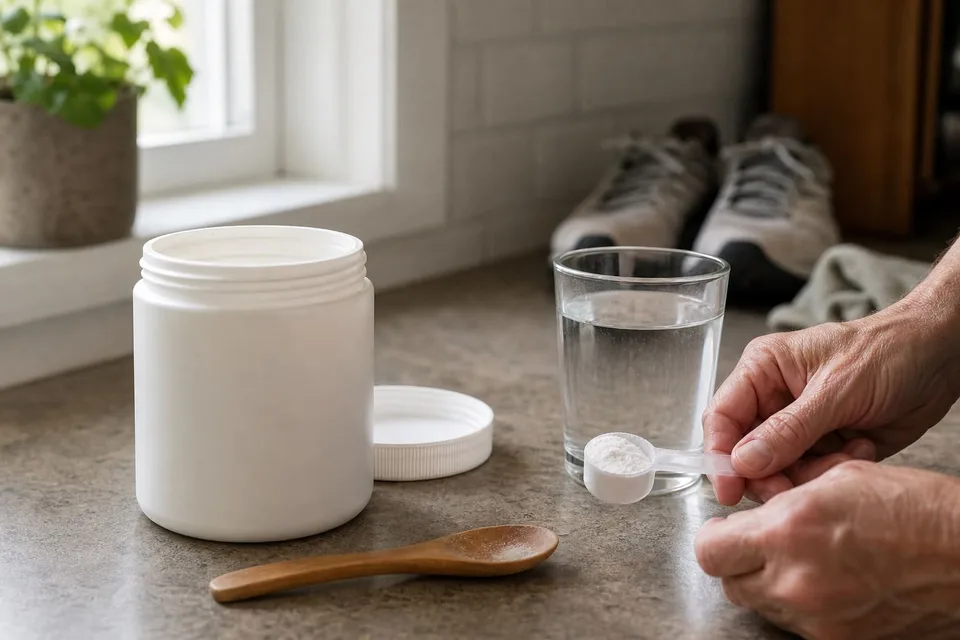
What creatine does in the body
Your cells run on ATP. When demand spikes, a molecule called phosphocreatine regenerates ATP within seconds, and creatine is the raw material for that backup system.
About 95% of your body's creatine sits in muscle, which is why the sports research came first. Your brain, though, is greedy. It's about 2% of your body weight and burns roughly 20% of your energy. It leans on the same phosphocreatine system when demand jumps, and its supply runs low with sleep loss, stress and age.
You get some creatine from food, mostly meat and fish, and your body makes about a gram a day. A supplement fills the tank in a way diet usually won't.
The brain studies
Memory. A 2023 meta analysis in Nutrition Reviews pooled randomized trials in healthy people and found creatine improved memory. The effect was large in older adults (66 to 76) and close to zero in younger ones. Dose, anywhere from about 2 to 20 g a day, didn't change the result (Prokopidis et al., Nutrition Reviews, 2023). A 2024 meta analysis of 16 trials and 492 adults also found a memory benefit, which it rated as moderate certainty, along with faster attention and processing times. It found no effect on overall cognition or executive function (Xu et al., Frontiers in Nutrition, 2024).
Notice who gained the most. It was the older group, and the biology predicts that. An aging brain has less energy in reserve, same as an aging muscle.
Vegetarians. In 128 young women given 20 g a day for 5 days or placebo, memory improved in the vegetarians but not in the meat eaters (Benton and Donohoe, British Journal of Nutrition, 2011). If you eat little or no meat, your starting tank is lower, and you have more to gain.
Sleep deprivation. This study is why creatine made headlines again. Researchers kept 15 healthy young adults awake for 21 hours and gave them either a single large dose of creatine (0.35 g per kg of body weight) or placebo, then swapped on a second night. Creatine improved memory and processing speed and reduced fatigue. The effect showed up about 3.5 hours after the dose, peaked around 4 hours and was still there at 9. Brain scans showed shifts in high energy phosphates and pH, the mechanism you'd expect (Gordji-Nejad et al., Scientific Reports, 2024).
That dose works out to about 25 g for a 70 kg person. It was one night in a lab with 15 people. It tells us a stressed, energy starved brain will take up creatine. It is not a daily protocol.
Getting creatine into the brain. This is where dose matters. Muscle soaks up most of what you swallow, and the brain only lets creatine in through a limited transporter. Brain scans show 20 g a day for 4 weeks raised total brain creatine by about 9% on average, with a wide range between people (Dechent et al., American Journal of Physiology, 1999). In a dose ranging trial, 10 g a day for 8 weeks raised frontal phosphocreatine by 9.1%, about twice the gain seen at 2 or 4 g, though the difference between groups wasn't statistically significant (Kondo et al., Amino Acids, 2016). In 20 people with Alzheimer's disease, 20 g a day (10 g twice daily) for 8 weeks raised brain creatine by 11%, and their scores on several thinking tests improved (Smith et al., Alzheimer's & Dementia: Translational Research & Clinical Interventions, 2025). That was an open label pilot with no placebo group, so treat the cognitive results as a hint. In six men with ALS, doses were stepped up a week at a time from 10 to 20 to 30 g a day, and brain creatine rose about 8% only at the top dose (Atassi et al., Amyotrophic Lateral Sclerosis, 2010). A 2024 review coauthored by Darren Candow, one of the most prolific creatine researchers, concluded that raising brain creatine likely takes 20 g a day or more for up to a week, or 4 g a day or more for several months, and that the best dose for brain function is still unknown (Candow et al., Aging and Health Research, 2024). The most careful review so far, published in 2026, went study by study and found that brain creatine most likely goes up with about 20 g a day, or 0.3 g per kg of body weight a day, taken for 4 weeks or longer. Studies that ran only 5 to 7 days mostly found no change. The authors also point out that many of the measured gains sit inside the scanners' margin of error, and that nobody has run a proper dose response trial yet (Pratt et al., The Journal of Nutritional Physiology, 2026).
The null results. Honesty matters here. A 6 week trial gave healthy young adults 10 g, 20 g or placebo daily and found no cognitive benefit at either dose (Moriarty et al., Brain Sciences, 2023). An earlier review of six trials found possible gains in short term memory and reasoning, conflicting results everywhere else and no change in young people (Avgerinos et al., Experimental Gerontology, 2018).
My read. Creatine helps the brain most when the brain is short on energy: older age, sleep loss, a vegetarian diet. Young, rested, well fed brains show little. No trial has proven a brain dose, and anyone who tells you otherwise is overselling. But the imaging data point one way. The brain fills slowly, it only takes in creatine through a limited transporter, and most of the studies that raised brain levels used 10 to 20 g a day for a month or more (the ALS study needed 30 g). The 3 to 5 g that fills muscle doesn't reliably move the brain. Rhonda Patrick, who has talked about this research at length, takes 10 g a day, split into two 5 g doses, and goes higher when she travels or sleeps poorly (FoundMyFitness).
So here's my firm opinion, based on my reading of these studies. It's not medical advice. For muscle, 3 to 5 g a day is enough. If brain health is your goal, and especially if you're over 40, vegetarian or often short on sleep, I'd take 10 to 20 g a day, split into doses of about 5 g, for at least 4 weeks. Start at 10 g. The 20 g end is where the brain imaging is strongest, but it's also where stomach upset gets more common. You'll see people online push 15 g as the brain dose. No trial has tested 15 g on its own, so I treat it as one point inside that range, not a magic number. Expect a modest edge on memory and on hard, sleep deprived days, not a new brain.
Mood
This result caught a lot of people off guard. A Korean team ran an 8 week, double blind, placebo controlled trial in 52 women with major depression who were starting escitalopram, a standard antidepressant. Half of them also took creatine, 3 g a day the first week and 5 g after that. The creatine group improved faster, starting by week 2. At week 8, 52% were in remission, compared with 25.9% on placebo (Lyoo et al., American Journal of Psychiatry, 2012).
It's one trial in one population, and creatine doesn't replace treatment for depression. As an add on, though, the effect was big and it needs to be repeated. If you're being treated for depression, that's a conversation for your doctor, not a reason to start on your own.
Muscle after 40
The original reason to take creatine still stands. After 40 you lose muscle and strength every decade unless you work to keep it. A 2017 meta analysis pooled 22 randomized trials covering 721 older adults on resistance training programs. The ones who added creatine gained 1.37 kg more lean mass and more upper and lower body strength than those on placebo (Chilibeck et al., Open Access Journal of Sports Medicine, 2017).
At 75, that can decide whether you take the stairs easily or need the rail.
Creatine won't build muscle on its own. It lets you train a bit harder and recover a bit better, and over months that adds up. Lift 2 to 3 days a week alongside it.
The safety myths
"It's bad for your kidneys." Not in healthy people. The International Society of Sports Nutrition reviewed the full body of evidence and concluded creatine monohydrate is safe short and long term, including up to 30 g a day for as long as five years, with no compelling evidence of harm in healthy people (Kreider et al., Journal of the International Society of Sports Nutrition, 2017).
The confusion comes from bloodwork. Creatine raises creatinine, a breakdown product doctors use to estimate kidney function. That rise is expected and doesn't mean your kidneys are damaged. Tell whoever reads your labs that you take it so they read the number correctly. If you already have kidney disease, skip creatine unless your kidney specialist signs off.
"It causes hair loss." That idea comes from one small 2009 study in rugby players, and it measured a hormone, not hair. No trial has shown creatine causes hair loss.
"It makes you bloated." A loading phase of 20 g a day can cause some water retention, mostly inside the muscle, and some stomach upset. Large single doses are the usual culprit, so split anything above 5 g. At 3 to 5 g a day, most people don't notice anything.
How I'd take it
Use creatine monohydrate. Nearly all the research used it, and it's the cheapest. Skip the fancy versions.
Take 3 to 5 g a day for muscle. That's the best studied dose. If your stomach is sensitive, start at 3 g for the first week.
For your brain, take 10 to 20 g a day, split into doses of about 5 g with food, for at least 4 weeks. Start at 10 g and move up only if your stomach handles it. Big single doses are the ones most likely to cause cramping or diarrhea. This is my opinion from the imaging and memory studies, not a proven dose.
Take it whenever you'll remember. Consistency beats timing. Coffee, a smoothie or plain water all work.
Skip loading. Without it, your stores fill in about 3 to 4 weeks. No need to cycle on and off either.
Buy product tested by a third party, NSF Certified for Sport or Informed Sport. The FDA hasn't approved supplements for these uses, so testing is how you know what's in the tub.
Lift 2 to 3 times a week. The muscle benefit depends on it.
Talk to your doctor first if you have kidney disease, are pregnant or breastfeeding, or take medicines that affect your kidneys. Creatine hasn't been studied well enough in pregnancy to call it safe, and with kidney disease, skip it unless your kidney specialist agrees.
Know the limits of the higher dose. The long safety record is strongest at 3 to 5 g a day, and the 2026 review calls for more safety data on brain level doses taken for months. If you have bipolar disorder, there are case reports of mania on creatine, so don't start it without your psychiatrist. And tell whoever orders your labs, because your creatinine will read higher.
The muscle case alone is enough reason to take it after 40, and it's cheap, safe and backed by hundreds of trials. The brain data are real but modest, and they're strongest in older adults and tired brains. Plain monohydrate, 3 to 5 grams for muscle, 10 to 20 grams in split doses if you're after the brain benefit, every day, with your lifting. Make the healthier choice easier to repeat.
The muscle trials and the kidney questions are already in creatine for healthy aging. If you are lifting to hold muscle on a GLP-1, pair this dose with the plan in your doctor should have told you this before your GLP-1. The easy cardio I want around that lifting is in everyone's doing Zone 2 wrong.
The science of a longer, stronger life.
A few useful follow-ups
How much creatine should I take for muscle after 40? If you lift, 3 to 5 grams of creatine monohydrate a day. That is the best studied dose for muscle. If your stomach is sensitive, start at 3 grams for the first week.
What dose do you use for the brain? My opinion, not medical advice: 10 to 20 grams a day, split into doses of about 5 grams, for at least 4 weeks. Start at 10 grams and move up only if your stomach handles it. No trial has tested 15 g on its own, so I treat 15 g as one point inside that range, not a special number.
Does creatine replace depression treatment? No. One trial added it to escitalopram in women with major depression. It does not replace treatment. If you are being treated for depression, that is a conversation for your doctor, not a reason to start on your own.
Who should check with a doctor first? If you have kidney disease, are pregnant or breastfeeding, or take medicines that affect your kidneys, talk to your doctor before you start. With kidney disease, skip creatine unless your kidney specialist agrees. If you have bipolar disorder, there are case reports of mania on creatine, so don't start it without your psychiatrist.
Sources
- Prokopidis K, et al. Effects of creatine supplementation on memory in healthy individuals: a systematic review and meta-analysis of randomized controlled trials. Nutrition Reviews. 2023;81(4):416-427. https://pubmed.ncbi.nlm.nih.gov/35984306/
- Xu C, Bi S, Zhang W, Luo L. The effects of creatine supplementation on cognitive function in adults: a systematic review and meta-analysis. Frontiers in Nutrition. 2024;11:1424972. https://doi.org/10.3389/fnut.2024.1424972
- Benton D, Donohoe R. The influence of creatine supplementation on the cognitive functioning of vegetarians and omnivores. British Journal of Nutrition. 2011;105(7):1100-1105. https://pubmed.ncbi.nlm.nih.gov/21118604/
- Gordji-Nejad A, et al. Single dose creatine improves cognitive performance and induces changes in cerebral high energy phosphates during sleep deprivation. Scientific Reports. 2024. https://doi.org/10.1038/s41598-024-54249-9
- Dechent P, et al. Increase of total creatine in human brain after oral supplementation of creatine-monohydrate. American Journal of Physiology. 1999;277(3):R698-R704. https://journals.physiology.org/doi/full/10.1152/ajpregu.1999.277.3.R698
- Kondo DG, et al. Creatine target engagement with brain bioenergetics: a dose-ranging phosphorus-31 magnetic resonance spectroscopy study of adolescent females with SSRI-resistant depression. Amino Acids. 2016. https://pmc.ncbi.nlm.nih.gov/articles/PMC4974294/
- Candow DG, et al. Does one dose of creatine supplementation fit all? Aging and Health Research. 2024. https://doi.org/10.1016/j.aehs.2024.05.002
- Smith AN, Choi IY, Lee P, Sullivan DK, et al. Creatine monohydrate pilot in Alzheimer's: Feasibility, brain creatine, and cognition. Alzheimer's & Dementia: Translational Research & Clinical Interventions. 2025. https://pmc.ncbi.nlm.nih.gov/articles/PMC12089086/
- Atassi N, Ratai EM, Greenblatt DJ, et al. A phase I, pharmacokinetic, dosage escalation study of creatine monohydrate in subjects with amyotrophic lateral sclerosis. Amyotrophic Lateral Sclerosis. 2010;11(6):508-513. https://pubmed.ncbi.nlm.nih.gov/20698808/
- Pratt J, Fuchs CJ, van Loon LJC, Kennerley AJ, Sale C. Creatine supplementation and brain health: Methodological challenges, current evidence, and translational perspectives. The Journal of Nutritional Physiology. 2026. https://www.jnutritionalphysiol.org/article/S3050-6247(26)00003-3/fulltext
- Moriarty T, et al. Dose-Response of Creatine Supplementation on Cognitive Function in Healthy Young Adults. Brain Sciences. 2023;13(9):1276. https://doi.org/10.3390/brainsci13091276
- Avgerinos KI, Spyrou N, Bougioukas KI, Kapogiannis D. Effects of creatine supplementation on cognitive function of healthy individuals: a systematic review of randomized controlled trials. Experimental Gerontology. 2018;108:166-173. https://doi.org/10.1016/j.exger.2018.04.013
- Patrick R. How Five Common Supplements Fit a Health Plan. FoundMyFitness. https://www.foundmyfitness.com/episodes/how-five-common-supplements-fit-a-health-plan
- Lyoo IK, Yoon S, Kim TS, et al. A randomized, double-blind placebo-controlled trial of oral creatine monohydrate augmentation for enhanced response to a selective serotonin reuptake inhibitor in women with major depressive disorder. American Journal of Psychiatry. 2012;169(9):937-945. https://doi.org/10.1176/appi.ajp.2012.12010009
- Chilibeck PD, Kaviani M, Candow DG, Zello GA. Effect of creatine supplementation during resistance training on lean tissue mass and muscular strength in older adults: a meta-analysis. Open Access Journal of Sports Medicine. 2017;8:213-226. https://doi.org/10.2147/OAJSM.S123529
- Kreider RB, Kalman DS, Antonio J, et al. International Society of Sports Nutrition position stand: safety and efficacy of creatine supplementation in exercise, sport, and medicine. Journal of the International Society of Sports Nutrition. 2017;14:18. https://doi.org/10.1186/s12970-017-0173-z