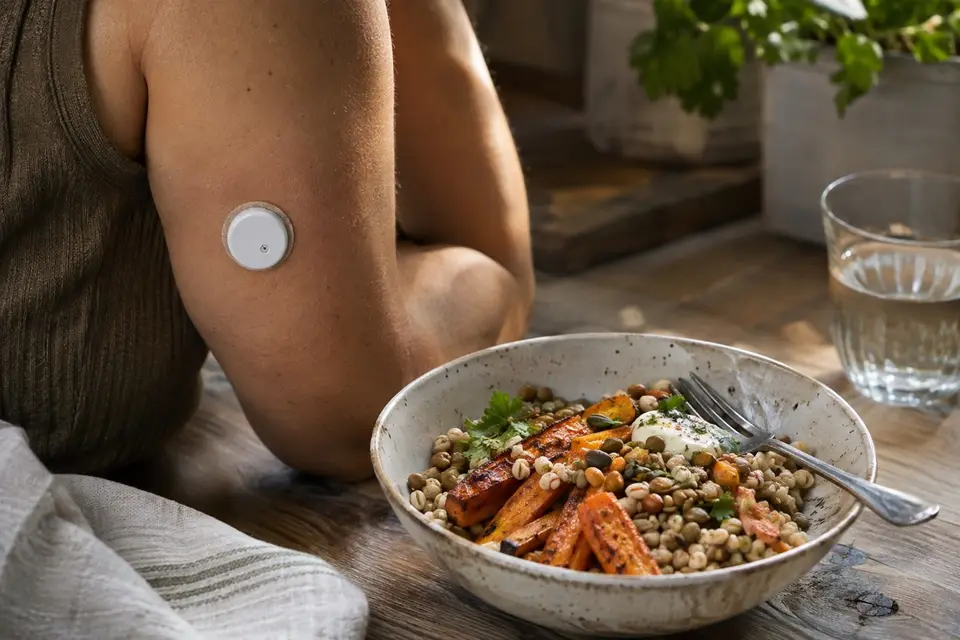
What matters most
Four things to remember
- 01
Decide what finding would change a decision.
- 02
Brief excursions occurred in people without diabetes.
- 03
A lab test can answer a screening question.
- 04
Review symptoms with a clinician.
01
What a healthy glucose trace looks like
In a multicenter study of 153 people without diabetes, participants wore a sensor during ordinary life. The median participant spent about 96% of the time between 70 and 140 mg/dL. Even in this selected healthy group, readings sometimes moved outside that interval. That descriptive range from a study is a poor basis for grading an individual lunch.
A sensor samples the fluid between cells. A peak has context: the time you ate, the portion, activity and the timing of the measurement. If a bean-and-rice lunch leaves you satisfied through the afternoon, a single rise provides little reason to remove the beans or skip the meal.
Shah et al., healthy participant sensor study · FDA, first over-the-counter glucose sensor clearance · NIDDK, diabetes tests and diagnosis
Put it into practice
A decision before buying a sensor
- 01
If the question is whether you have diabetes, ask which laboratory test fits your situation. A consumer sensor cannot establish a diagnosis.
- 02
If you want a more filling lunch, try adding lentils, tofu or vegetables to a familiar meal. Judge whether it is enjoyable and keeps you satisfied.
- 03
If your clinician suggests monitoring for a specific reason, agree in advance on what finding would change your care and who will interpret it.
Safety first
When general advice is not enough
- The FDA’s first over-the-counter clearance had specific limits, including insulin use and problematic hypoglycemia. Follow your own device’s labeling. Seek medical advice for recurrent symptoms such as marked thirst or frequent urination, even if a consumer trace looks reassuring.
A few useful follow ups
Can one glucose spike diagnose prediabetes?
Diagnosis relies on standard blood testing. One post-meal sensor value has no established diagnostic cutoff for prediabetes.
Should I stop eating fruit if my reading rises?
One reading is too little information to justify a lasting restriction. Consider the whole meal, your usual eating pattern and any specific clinical advice.
Related reading
Build the full picture
Sources and further reading
Primary guidance and research reviewed for this article.
Shah et al., healthy participant sensor study ↗FDA, first over-the-counter glucose sensor clearance ↗NIDDK, diabetes tests and diagnosis ↗
Sung Won, MD
A longevity & performance educator and health coach focused on evidence-based longevity, plant-forward nutrition, and habits people can sustain. His career began in orthopedic spine surgery.
Read the full biography →